


Eli Lilly and Co Stock (LLY) Closed Down by 3.55% on Nov 5: A Full Analysis


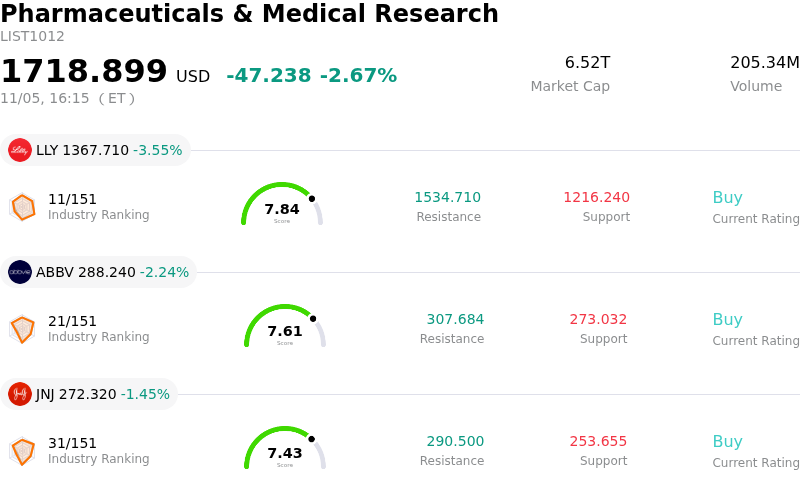
Eli Lilly and Co (LLY) closed down by 3.55%. The Pharmaceuticals & Medical Research sector is down by 2.67%. The company underperformed the industry. Top 3 stocks by turnover in the sector: Eli Lilly and Co (LLY) down 3.55%; AbbVie Inc (ABBV) down 2.24%; Johnson & Johnson (JNJ) down 1.45%.
What is driving Eli Lilly and Co (LLY)’s stock price down today?
Eli Lilly experienced downward pressure during the session as a combination of elevated valuation sensitivity, competitive dynamics in the metabolic space, and institutional profit-taking weighed on shares. Following an extended run of outperformance driven by its commercial incretin portfolio, the stock has traded at a significant premium to the broader pharmaceutical sector. In this context, any shift in broader market sentiment or macro factor rotation tends to trigger tactical derisking among institutional funds seeking to harvest gains in mega-cap healthcare leaders.
A primary operational focus for the market remains the evolving competitive and supply landscape within the obesity and diabetes categories. As multiple peers accelerate clinical trials for next-generation dual and triple agonists, as well as oral small-molecule alternatives, investors are increasingly scrutinizing the durability of market share and long-term pricing power for core drivers such as tirzepatide. Additionally, fluctuations in wholesaler inventory levels, periodic supply chain adjustments, and regulatory scrutiny surrounding compounding alternatives introduce short-term variability into volume projections. While commercial demand remains robust, heightened investor expectations leave minimal margin for transitory execution bottlenecks.
Macroeconomic conditions and cross-asset flows have further exacerbated the pullback. Institutional portfolio rebalancing often leads to capital reallocation out of high-multiple healthcare compounders into cyclicals or interest-rate-sensitive assets. As yields adjust to shifting macroeconomic data and central bank policy expectations, growth-oriented pharmaceutical equities with elevated multiples experience natural multiple compression, regardless of their underlying operational health.
Despite the intraday decline, Eli Lilly maintains a formidable strategic moat anchored by substantial manufacturing capital expenditures, expanding global capacity, and an extensive clinical pipeline spanning cardiometabolic diseases, oncology, and neuroscience. From an institutional perspective, sessions characterized by volatility without fundamental thesis impairment often serve to reset valuation multiples to more sustainable levels rather than signaling a structural reversal in the company long-term commercial trajectory.
Technical Analysis of Eli Lilly and Co (LLY)
Technically, Eli Lilly and Co (LLY) shows a MACD (12,26,9) value of 20.313, indicating a buy signal. The RSI at 64.034 suggests neutral condition and the Williams %R at 38.926 suggests buy condition. Please monitor closely.
Media Coverage of Eli Lilly and Co (LLY)
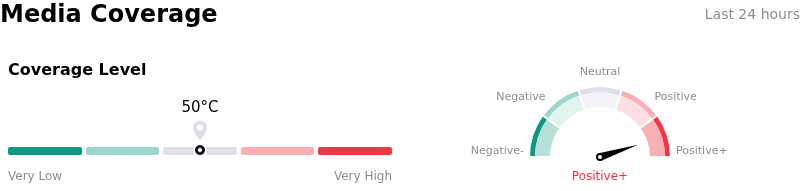
In terms of media coverage, Eli Lilly and Co (LLY) shows a coverage score of 50, indicating a moderate level of media attention. The overall market sentiment index is currently in extremely bullish zone.
Fundamental Analysis of Eli Lilly and Co (LLY)
Eli Lilly and Co (LLY) is in the Pharmaceuticals & Medical Research industry. Its latest annual revenue is $65.18B, ranking 4 in the industry. The net profit is $20.64B, ranking 2 in the industry. Company Profile
Over the past month, multiple analysts have rated the company as Buy, with an average price target of $1438.09, a high of $1690.00, and a low of $891.22.
More details about Eli Lilly and Co (LLY)
Company Specific Risks:
- Accelerating Net Price Erosion and Margin Compression: Recent Q3 disclosures and analyst assessments highlight that worldwide realized prices dropped 15% (with international realized prices declining 29%), driven by expanding enrollment in discounted access channels such as Medicare's GLP-1 Bridge program, creating significant net-price headwinds that threaten operating margins despite strong volume growth.
- Foundayo Commercial Underperformance and Market Share Deficit: Eli Lilly's newly approved oral weight-loss therapy, Foundayo, missed consensus expectations by posting $184 million versus the $217 million forecast. Concurrently, prescription data indicates Lilly controls only ~25% of the oral GLP-1 market compared to Novo Nordisk's dominant ~75% share, elevating execution risk in the critical oral drug vertical.
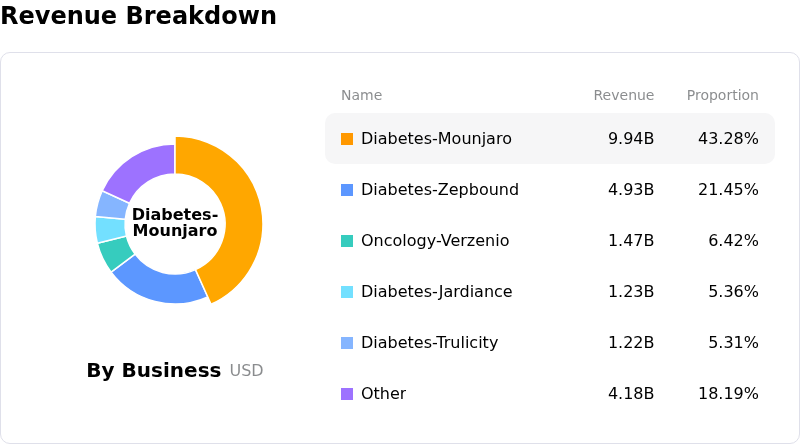
- Revenue Over-Concentration in the Incretin Franchise: Over 65.9% of company-wide revenue is now consolidated within just two medications, Mounjaro and Zepbound, exposing the firm to severe single-franchise downside from evolving government drug price negotiations, potential pipeline safety signals, and aggressive competitor trial readouts.
- High Valuation Multiple Vulnerability Ahead of a 2027 Comp Cliff: Trading at elevated multiples above 39x forward earnings and ~45x trailing P/E, institutional analysts warn that approximately $2 billion of non-recurring revenue recognized in 2026 will create difficult year-over-year comparables for 2027, leaving the stock highly vulnerable to sharp multiple contraction if organic volume growth decelerates.
This article may include AI-generated content that is human-reviewed, which is for reference and general information purposes only and does not constitute investment advice.
Recommended Articles







Comments (0)
Click the $ button, enter the symbol, and select to link a stock, ETF, or other ticker.