


Mitsubishi UFJ Financial Group Inc Stock (MUFG) Moved Down by 3.14% on Nov 5: What Signal Does It Send?


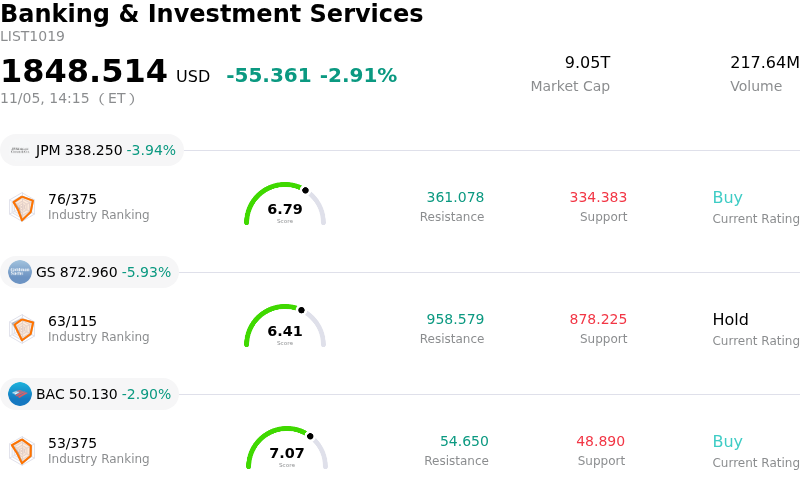
Mitsubishi UFJ Financial Group Inc (MUFG) moved down by 3.14%. The Banking & Investment Services sector is down by 2.91%. The company underperformed the industry. Top 3 stocks by turnover in the sector: JPMorgan Chase & Co (JPM) down 3.98%; Goldman Sachs Group Inc (GS) down 6.02%; Bank of America Corp (BAC) down 2.98%.
What is driving Mitsubishi UFJ Financial Group Inc (MUFG)’s stock price down today?
Shares of Mitsubishi UFJ Financial Group experienced noticeable downward pressure during the session, driven primarily by shifting macroeconomic expectations, interest rate sensitivity, and broad-based profit taking across the banking sector. As Japan’s largest financial institution, MUFG’s performance is tightly linked to sovereign yield curves, central bank policy signaling, and global financial conditions, all of which faced headwinds.
A key factor weighing on sentiment is the recalibration of monetary policy expectations. Japanese financial equities have seen strong structural interest on expectations of sustained rate normalization by the Bank of Japan, which supports net interest margin expansion. However, recent stabilization or pullback in domestic bond yields, paired with mixed signals regarding the pacing of future rate adjustments, has tempered near-term margin expectations. When sovereign yields soften, the momentum trade in mega-banks often experiences quick tactical de-risking from institutional investors.
Currency dynamics have added to the selling pressure. Movements in the yen relative to the U.S. dollar influence MUFG’s cross-border earnings and valuation profiles. A strengthening yen reduces the translated value of overseas profits and can trigger an unwinding of broader equity positions by foreign institutional funds. At the same time, fluctuations in U.S. Treasury yields have created cross-currents for the bank’s international lending and fixed-income portfolios, introducing caution regarding net unrealized securities valuations.
The broader international banking landscape also contributed to the pullback. As global financial markets navigate economic uncertainty, risk sentiment across money-center institutions has grown cautious. With earnings season either underway or approaching, institutional managers frequently opt to lock in gains on outperforming financial names. Given MUFG’s multi-quarter strength, profit-taking and portfolio rebalancing away from cyclical bank shares toward more defensive allocations represented a natural dampener on the stock.
Looking ahead, institutional focus will remain on the trajectory of domestic interest rates, the Bank of Japan’s policy guidance, and the resilience of domestic credit demand. While the long-term structural thesis of yield curve normalization remains intact, near-term trading is likely to stay volatile as markets digest macroeconomic data releases and global interest rate trends.
Technical Analysis of Mitsubishi UFJ Financial Group Inc (MUFG)
Technically, Mitsubishi UFJ Financial Group Inc (MUFG) shows a MACD (12,26,9) value of 0.073, indicating a neutral signal. The RSI at 42.226 suggests neutral condition and the Williams %R at 63.333 suggests sell condition. Please monitor closely.
Fundamental Analysis of Mitsubishi UFJ Financial Group Inc (MUFG)
Mitsubishi UFJ Financial Group Inc (MUFG) is in the Banking & Investment Services industry. Its latest annual revenue is $42.22B, ranking 10 in the industry. The net profit is $11.47B, ranking 8 in the industry. Company Profile
Over the past month, multiple analysts have rated the company as Strong Buy, with an average price target of $26.53, a high of $26.53, and a low of $26.53.
More details about Mitsubishi UFJ Financial Group Inc (MUFG)
Company Specific Risks:
- Unrealized Bond Portfolio Losses Amid Yield Curve Steepening: Surging Japanese Government Bond (JGB) yields and volatile global benchmark rates have intensified mark-to-market stress on MUFG's fixed-income holdings, heightening scrutiny over substantial unrealized portfolio losses and elevated revaluation costs on interest rate hedges.
- Capital Buffer Depletion Below Target CET1 Band: Institutional analysts have flagged that MUFG's fully implemented Basel III Common Equity Tier 1 (CET1) ratio has slipped to approximately 9.2%, falling below management's internal target corridor of 9.5%–10.5% and constraining capital flexibility for future share repurchases.
- Monetary Policy Normalization Priced In Amid Multiple Compression: Recent analyst commentary, including cautious hold ratings, warns that net interest margin expansion from Bank of Japan policy rate increases is already fully reflected in share prices, leaving the bank vulnerable to multiple contraction as domestic loan demand remains structurally sluggish.
- Rising Credit Cost Exposure Across Emerging Market Assets: Aggressive international balance sheet expansion into Southeast Asian and Indian lending operations has increased MUFG's exposure to regional non-performing loans, elevating consolidated credit costs and dampening returns from overseas banking subsidiaries.
This article may include AI-generated content that is human-reviewed, which is for reference and general information purposes only and does not constitute investment advice.
Recommended Articles







Comments (0)
Click the $ button, enter the symbol, and select to link a stock, ETF, or other ticker.