


RTX Corp Stock (RTX) Moved Down by 3.09% on Nov 5: Drivers Behind the Movement


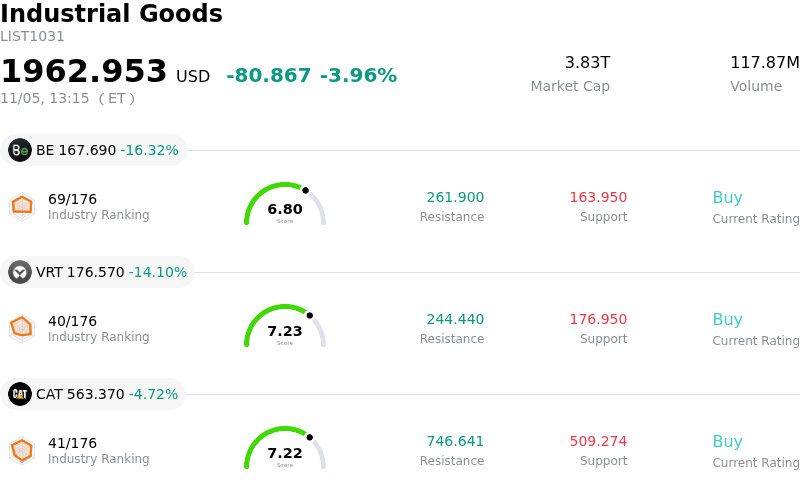
RTX Corp (RTX) moved down by 3.09%. The Industrial Goods sector is down by 3.96%. The company outperformed the industry. Top 3 stocks by turnover in the sector: Bloom Energy Corp (BE) down 16.46%; Vertiv Holdings Co (VRT) down 13.98%; Caterpillar Inc (CAT) down 4.72%.
What is driving RTX Corp (RTX)’s stock price down today?
RTX shares encountered notable selling pressure, driven by sector-wide policy uncertainty, valuation consolidation, and macro-driven institutional portfolio adjustments across the aerospace and defense landscape. The primary catalyst behind the pullback centers on shifting political dynamics and heightened scrutiny surrounding federal budget appropriations. With fresh developments altering the legislative balance and governance outlook in Washington, market participants quickly reassessed the trajectory of multi-year defense spending and procurement growth. Concerns that ambitious military budget increases could face legislative pushback or delays prompted investors to recalibrate their exposure across prime contractors, triggering coordinated weakness in the peer group.
Compounding the defense budget debate is short-term profit-taking following a prolonged run of strong performance. RTX had recently traded near multi-month highs on the heels of robust quarterly financial results, which featured solid top-line expansion and upward revisions to full-year guidance. However, the post-earnings digestion has brought greater scrutiny to the underlying composition of recent earnings, including one-time tariff cost recoveries and quarter-over-quarter variability in free cash flow generation. With valuation multiples elevated relative to historical levels, institutional desks used the emergence of political headline risk as a clear trigger to trim exposure and lock in recent gains.
Broader macroeconomic conditions also reinforced downward pressure on industrial equities. Lingering interest rate volatility and elevated Treasury yields created headwinds for capital-intensive industrial and defense names, prompting systematic funds and asset allocators to rotate toward less politically sensitive cyclical pockets. Furthermore, ongoing supply chain bottlenecks and extended maintenance timelines within commercial engine operations continue to act as an operational overhang, preventing multiple expansion in the absence of fresh positive catalysts.
Despite the near-term retrenchment, RTX continues to hold solid fundamental backing, underpinned by a historic order backlog, persistent demand across commercial aftermarket services, and vital positioning in missile defense programs. For institutional investors, the current sell-off appears primarily structural and sentiment-driven rather than an indication of deteriorating operational capabilities, though heightened congressional budget volatility is likely to maintain sector-wide price fluctuations in the near term.
Technical Analysis of RTX Corp (RTX)
Technically, RTX Corp (RTX) shows a MACD (12,26,9) value of 1.274, indicating a buy signal. The RSI at 46.707 suggests neutral condition and the Williams %R at 76.732 suggests sell condition. Please monitor closely.
Media Coverage of RTX Corp (RTX)
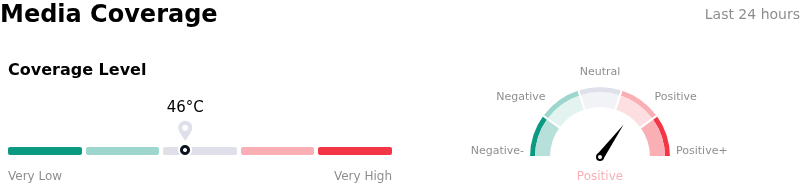
In terms of media coverage, RTX Corp (RTX) shows a coverage score of 46, indicating a moderate level of media attention. The overall market sentiment index is currently in bullish zone.
Fundamental Analysis of RTX Corp (RTX)
RTX Corp (RTX) is in the Industrial Goods industry. Its latest annual revenue is $88.60B, ranking 2 in the industry. The net profit is $6.73B, ranking 2 in the industry. Company Profile
Over the past month, multiple analysts have rated the company as Buy, with an average price target of $224.41, a high of $252.00, and a low of $164.00.
More details about RTX Corp (RTX)
Company Specific Risks:
- Defense Budget and Legislative Allocation Overhang: Recent congressional shifts have heightened scrutiny over proposed military spending expansions, sparking institutional de-risking across defense primes and elevating concerns regarding timeline delays and budget caps affecting RTX's $164 billion defense backlog.
- Severe Free Cash Flow Contraction and Earnings Quality Concerns: Heightened analyst scrutiny has focused on RTX's 47% year-over-year drop in quarterly free cash flow to $2.12 billion, coupled with an outsized reliance on $0.25 per share ($400 million) in one-off IEEPA tariff cost recoveries to drive headline earnings beats.
- Pratt & Whitney Margin Strain and Fleet Liabilities: Operating profit at Pratt & Whitney declined 19% to $608 million due to a $363 million customer bankruptcy charge, while lingering PW1100-powered A320neo aircraft-on-ground liabilities continue to suppress commercial aerospace margins and tie up operational capital.
- Elevated Valuation Multiples Triggering Institutional Trims: Trading at roughly 32 times earnings, RTX faces downside intraday volatility as institutional funds accelerate profit-taking and multiple consolidation amid broader cyclical rotations away from defense contractors.
This article may include AI-generated content that is human-reviewed, which is for reference and general information purposes only and does not constitute investment advice.
Recommended Articles







Comments (0)
Click the $ button, enter the symbol, and select to link a stock, ETF, or other ticker.