


HSBC Holdings PLC Stock (HSBC) Moved Down by 6.32% on Oct 27: Key Drivers Unveiled



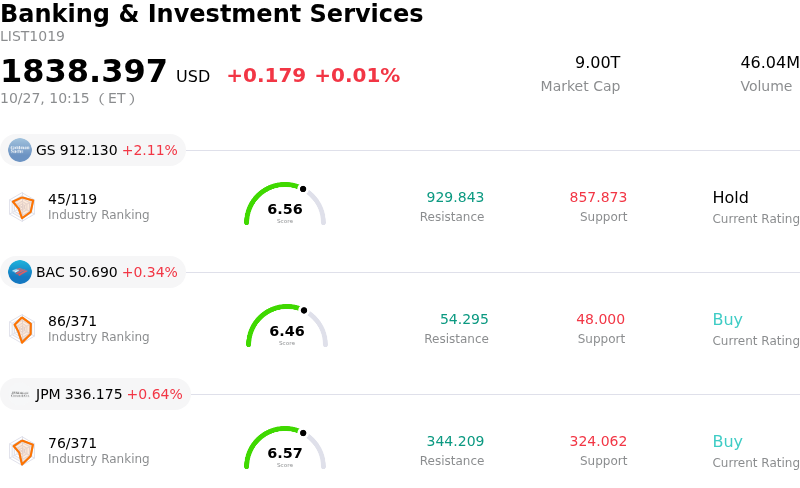
HSBC Holdings PLC (HSBC) moved down by 6.32%. The Banking & Investment Services sector is up by 0.01%. The company underperformed the industry. Top 3 stocks by turnover in the sector: Goldman Sachs Group Inc (GS) up 2.11%; Bank of America Corp (BAC) up 0.34%; JPMorgan Chase & Co (JPM) up 0.64%.
What is driving HSBC Holdings PLC (HSBC)’s stock price down today?
HSBC experienced notable downward pressure during the trading session following the release of its third-quarter financial results. Although reported pre-tax profits showed year-over-year expansion—largely benefiting from reduced legal provisions compared to the prior-year period—headline revenue and overall earnings failed to meet consensus expectations. Investor disappointment was further compounded by a noticeable slowdown in the bank's wealth management division, which saw revenue growth flatten after previous quarters of strong double-digit expansion, signaling emerging execution friction in one of HSBC's primary growth engines.
Market sentiment was additionally impacted by management's decision to maintain, rather than raise, its full-year financial guidance targets for banking net interest income and return on tangible equity. Given the ongoing tailwinds from elevated global interest rates, market participants had priced in potential upward guidance revisions. Furthermore, escalating deposit competition across HSBC's core geographic hubs, particularly Hong Kong and the United Kingdom, continues to elevate funding costs and put pressure on underlying margins, raising concerns over near-term profitability trends.
Capital return initiatives provided limited cushion against the post-earnings sell-off. While the board authorized a new share buyback program alongside an interim dividend, the repurchasing scope was already anticipated by institutional investors and represents a reduced pace relative to earlier buyback programs. External macroeconomic and policy headwinds, including market apprehension around potential UK banking tax revisions, further weighed on investor appetite and fueled broad-based volatility across the financial sector.
Technical Analysis of HSBC Holdings PLC (HSBC)
Technically, HSBC Holdings PLC (HSBC) shows a MACD (12,26,9) value of -0.902, indicating a sell signal. The RSI at 23.703 suggests sell condition and the Williams %R at 94.835 suggests oversold condition. Please monitor closely.
Fundamental Analysis of HSBC Holdings PLC (HSBC)
HSBC Holdings PLC (HSBC) is in the Banking & Investment Services industry. Its latest annual revenue is $69.62B, ranking 4 in the industry. The net profit is $21.10B, ranking 3 in the industry. Company Profile
Over the past month, multiple analysts have rated the company as Buy, with an average price target of $108.62, a high of $115.24, and a low of $102.00.
More details about HSBC Holdings PLC (HSBC)
Company Specific Risks:
- Q3 Revenue Miss and Wealth Segment Deceleration: HSBC reported Q3 revenue of $18.6 billion, falling short of consensus expectations of $18.93 billion, largely due to weaker net interest income and a sharp growth slowdown in its key wealth management division.
- Intensifying Deposit Competition and Margin Squeeze: Escalating deposit competition across core markets in Hong Kong and the UK is pushing client balances into higher-yielding time deposits, driving up funding costs and pressuring net interest margins.
- Deterioration of Core Capital Buffer: The bank's Common Equity Tier 1 (CET1) capital ratio slipped to 13.9%, dropping below management's target band of 14% to 14.5% and raising concerns over capital adequacy amid ongoing share buyback commitments.
- UK Banking Tax and Regulatory Overhang: Market anxiety surrounding potential banking tax hikes in the upcoming UK Autumn Budget poses a regulatory threat that could curtail earnings growth and constrain future capital returns.
This article may include AI-generated content that is human-reviewed, which is for reference and general information purposes only and does not constitute investment advice.
Recommended Articles









Comments (0)
Click the $ button, enter the symbol, and select to link a stock, ETF, or other ticker.