


Banco Bradesco SA Stock (BBDO) Moved Down by 23.43% on Oct 26: A Full Analysis



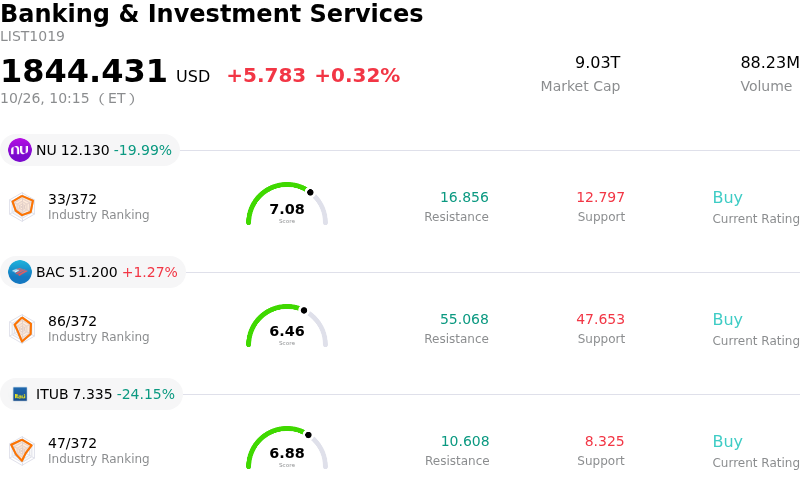
Banco Bradesco SA (BBDO) moved down by 23.43%. The Banking & Investment Services sector is up by 0.32%. The company underperformed the industry. Top 3 stocks by turnover in the sector: Nu Holdings Ltd (NU) down 19.76%; Bank of America Corp (BAC) up 1.26%; Itau Unibanco Holding SA (ITUB) down 24.09%.
What is driving Banco Bradesco SA (BBDO)’s stock price down today?
The sharp downward pressure on Banco Bradesco S.A. ADRs is primarily driven by a macro-political shock originating in Brazil. Following the presidential runoff election, market expectations for a market-friendly administrative outcome were disrupted. Investors who had aggressively positioned for fiscal consolidation and regulatory easing rushed to unwind consensus positions in Brazilian equities. The sudden shift in political sentiment triggered widespread capital flight from Latin American financial assets, with bank ADRs bearing the brunt of the repricing as concerns re-emerged regarding fiscal discipline, government debt trajectories, and potential domestic interest rate dynamics.
Compounding the equity market sell-off, the Brazilian real experienced acute weakness against the U.S. dollar. Because American Depositary Shares are dollar-denominated derivatives of local real-denominated assets, currency depreciation mechanically depresses the dollar-equivalent valuation of Bradesco's earnings and balance sheet. Furthermore, the broad financial sector faced collateral pressure as elevated sovereign risk premiums and higher domestic funding costs threaten to squeeze net interest margins across major Brazilian commercial banks.
Company-specific fundamental factors have amplified negative sentiment following the bank's recent quarterly financial report. Although top-line revenues and loan volume displayed expansion, asset quality metrics signaled ongoing deterioration. An uptick in non-performing loans, driven by stress in consumer and small-to-medium enterprise portfolios, forced a substantial increase in loan-loss provisions. Management's commentary indicating that credit quality normalization may extend well into 2027 has dampened near-term earnings visibility and heightened risk aversion among institutional investors.
Technical and structural trading dynamics exacerbated the intraday move. Prior to the election, the stock had experienced a strong rally, leaving shares vulnerable to aggressive profit-taking and momentum unwinding. Additionally, the lower trading liquidity characteristic of the common ADR listing relative to domestic preferred shares intensified price volatility. In an environment of heightened broad-market risk aversion, thin market depth led to amplified downward order imbalances, resulting in severe intraday fluctuations.
Technical Analysis of Banco Bradesco SA (BBDO)
Technically, Banco Bradesco SA (BBDO) shows a MACD (12,26,9) value of -0.146, indicating a neutral signal. The RSI at 32.577 suggests neutral condition and the Williams %R at 98.502 suggests oversold condition. Please monitor closely.
Fundamental Analysis of Banco Bradesco SA (BBDO)
Banco Bradesco SA (BBDO) is in the Banking & Investment Services industry. Its latest annual revenue is $25.31B, ranking 23 in the industry. The net profit is $4.66B, ranking 27 in the industry. Company Profile
Over the past month, multiple analysts have rated the company as Buy, with an average price target of $22.19, a high of $28.00, and a low of $16.00.
More details about Banco Bradesco SA (BBDO)
Company Specific Risks:
- Analyst Downgrades and Rating Divergence: Recent sell-side rating downgrades, including HSBC cutting its rating to Hold with a $3.90 price target, have created institutional sell pressure and capped upside momentum.
- High Financial Leverage: Banco Bradesco carries an elevated debt-to-equity ratio of approximately 2.93, increasing balance sheet risk and interest expense sensitivity during periods of elevated credit tightening.
- Emerging Market Bond and Interest Rate Volatility: Global bond yield spikes and shifting domestic benchmark interest rate (Selic) expectations continue to trigger capital volatility and intraday sell-offs in Brazilian banking equities.
- Competitive Margin Compression from Fintech Expansion: Rapid market expansion by Brazilian neobanks and digital payment platforms continues to pressure traditional retail credit and service fee margins, compelling heavy ongoing investments in digital infrastructure.
This article may include AI-generated content that is human-reviewed, which is for reference and general information purposes only and does not constitute investment advice.
Recommended Articles








Comments (0)
Click the $ button, enter the symbol, and select to link a stock, ETF, or other ticker.