


Charter Communications Inc Stock (CHTR) Moved Down by 7.31% on Sep 9: Key Drivers Unveiled



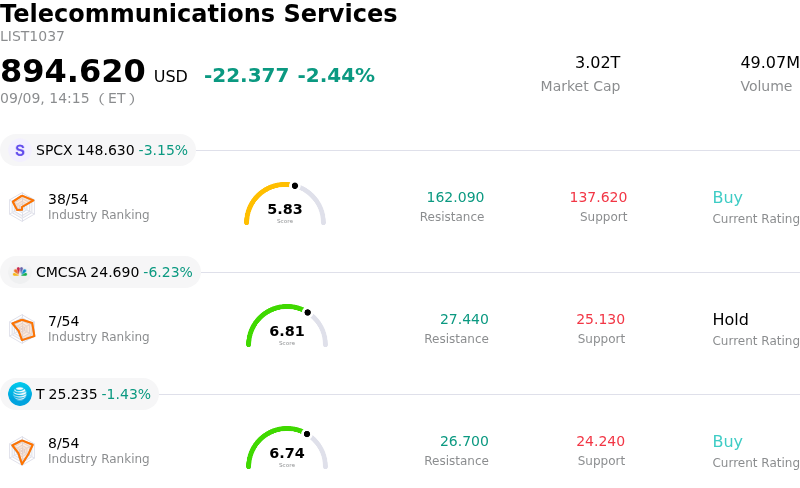
Charter Communications Inc (CHTR) moved down by 7.31%. The Telecommunications Services sector is down by 2.44%. The company underperformed the industry. Top 3 stocks by turnover in the sector: SpaceX (SPCX) down 3.18%; Comcast Corp (CMCSA) down 6.23%; AT&T Inc (T) down 1.43%.
What is driving Charter Communications Inc (CHTR)’s stock price down today?
Charter Communications experienced significant downside pressure as a targeted repricing swept across the cable broadband sector. The sharp decline was primarily triggered by heightened market anxiety over persistent structural headwinds facing traditional cable operators. Investors remain concerned about aggressive competition from telecom rivals expanding fixed wireless access and high-speed fiber networks. These alternative technologies continue to capture market share, eroding cable's historic subscriber growth and pricing power in residential broadband. Furthermore, heightened scrutiny accompanied senior leadership appearances at major September investor conferences, where market participants anticipated cautious commentary regarding current-quarter subscriber trends and customer acquisition costs.
Company-specific developments have added an extra layer of caution for market participants. The upcoming leadership transition in the finance department, marked by the Chief Financial Officer stepping down in mid-October, introduces temporary administrative uncertainty during a period of significant strategic integration. Charter has recently absorbed major cable and media assets through complex corporate combinations, increasing overall leverage and capital expenditure burdens. While management has implemented proactive retention strategies, such as offering bundled streaming services at no extra charge to low-income and legacy tiers to mitigate churn, the market remains cautious about the near-term cash flow impact of these promotional efforts.
From an institutional research perspective, Charter continues to navigate a challenging macro and operational landscape characterized by ongoing cord-cutting in video and margin pressure in high-margin internet services. Although mobile line expansion offers a viable long-term strategy for convergence and customer retention, it has not yet fully counterbalanced subscriber attrition in core broadband products. Until Charter demonstrates sustained stabilization in broadband net additions and provides a clearer timeline for balance sheet deleveraging, the shares are likely to face ongoing valuation headwinds and heightened intraday volatility relative to the broader media and communications sector.
Technical Analysis of Charter Communications Inc (CHTR)
Technically, Charter Communications Inc (CHTR) shows a MACD (12,26,9) value of -3.532, indicating a neutral signal. The RSI at 40.405 suggests neutral condition and the Williams %R at 96.597 suggests oversold condition. Please monitor closely.
Media Coverage of Charter Communications Inc (CHTR)
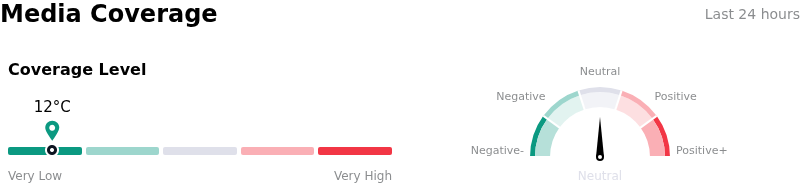
In terms of media coverage, Charter Communications Inc (CHTR) shows a coverage score of 12, indicating a very low level of media attention. The overall market sentiment index is currently in neutral zone.
Fundamental Analysis of Charter Communications Inc (CHTR)
Charter Communications Inc (CHTR) is in the Telecommunications Services industry. Its latest annual revenue is $54.77B, ranking 5 in the industry. The net profit is $4.99B, ranking 6 in the industry. Company Profile
Over the past month, multiple analysts have rated the company as Hold, with an average price target of $227.34, a high of $700.00, and a low of $101.00.
More details about Charter Communications Inc (CHTR)
Company Specific Risks:
- Broadband Repricing Pressure and Core Churn: Charter stock experienced a steep intraday decline of roughly 6% amid heightened market fears of sector-wide broadband price wars and ongoing subscriber attrition across core internet and residential service segments.
- CFO Leadership Transition Uncertainty: The announced resignation of Chief Financial Officer Jessica Fischer, effective October 15, 2026, forces a transition to an interim CFO during a major corporate restructuring, creating execution and strategic continuity risks for institutional investors.
- Balance Sheet Leverage and Capital Intensity: Following the Cox transaction, Charter assumed $840 million in additional net debt while projecting $11.4 billion in 2026 capital expenditures, forcing management to temporarily pause share buybacks to focus on debt reduction.
- Accelerated Cord-Cutting and Margin Compression: Persistent double-digit declines in traditional cable television subscriptions continue to drag down video revenues, compressing operating EBITDA margins despite aggressive network evolution spending.
This article may include AI-generated content that is human-reviewed, which is for reference and general information purposes only and does not constitute investment advice.
Recommended Articles








Comments (0)
Click the $ button, enter the symbol, and select to link a stock, ETF, or other ticker.