


SpaceX Stock (SPCX) Moved Up by 4.86% on Aug 7: A Full Analysis



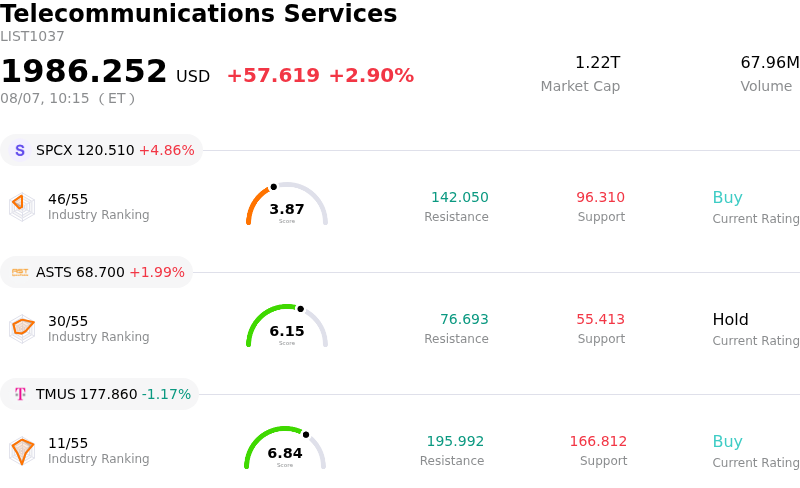
SpaceX (SPCX) moved up by 4.86%. The Telecommunications Services sector is up by 2.90%. The company outperformed the industry. Top 3 stocks by turnover in the sector: SpaceX (SPCX) up 4.86%; AST SpaceMobile Inc (ASTS) up 2.56%; T-Mobile US Inc (TMUS) down 1.17%.
What is driving SpaceX (SPCX)’s stock price up today?
The upward movement in SPCX today reflects a significant shift in investor appetite for early-stage growth companies and blank-check vehicles. This resurgence is primarily driven by a stabilization in the macroeconomic environment, where recent cooling inflation data has prompted a reassessment of discount rates applied to long-duration assets. As a result, the pre-merger SPACs held within the fund's portfolio, which typically trade close to their net asset value, are seeing renewed interest as the downside risk appears capped relative to the potential upside of new deal announcements.
Beyond macro factors, the intraday volatility and subsequent climb are linked to a flurry of definitive agreement announcements within the clean energy and artificial intelligence sectors. Several high-valuation private companies have signaled their intent to go public via merger, revitalizing a segment of the market that had previously faced skepticism. The active management strategy of this ETF allows it to pivot toward these high-conviction targets, and the market is currently rewarding the fund’s positioning in sponsors with proven track records of closing quality deals.
Improvements in the regulatory landscape have also played a role. Clearer guidelines from the Securities and Exchange Commission regarding financial projections and liability have reduced the uncertainty discount that previously plagued the SPAC asset class. Furthermore, institutional portfolio rebalancing has seen a rotation back into speculative growth as a hedge against stagnating returns in defensive large-cap equities. The heightened trading volume suggests that both retail and institutional players are viewing the current environment as a tactical opportunity to capture the gains often associated with successful business combinations.
Despite the positive momentum, investors should remain cognizant of the inherent risks associated with SPACs, including the potential for high redemption rates and post-merger dilution. The current volatility underscores the sensitive nature of these instruments to shifts in market liquidity. However, for the time being, the combination of favorable interest rate expectations and a robust pipeline of private companies seeking public exits is providing a strong tailwind for the fund's performance.
Technical Analysis of SpaceX (SPCX)
Technically, SpaceX (SPCX) shows a MACD (12,26,9) value of -4.056, indicating a sell signal. The RSI at 47.102 suggests neutral condition and the Williams %R at 59.721 suggests sell condition. Please monitor closely.
Fundamental Analysis of SpaceX (SPCX)
SpaceX (SPCX) is in the Telecommunications Services industry. Its latest annual revenue is $18.67B, ranking 10 in the industry. The net profit is $-4.94B, ranking 61 in the industry. Company Profile
Over the past month, multiple analysts have rated the company as Buy, with an average price target of $234.23, a high of $800.00, and a low of $117.00.
More details about SpaceX (SPCX)
p>Company Specific Risks:
- SEC Regulatory Compliance Costs: The implementation of stringent SEC disclosure rules for de-SPAC transactions has significantly increased legal and accounting overhead for sponsors, narrowing the pipeline of high-quality "New Issues" available for the fund's acquisition strategy.
- High Redemption Rate Vulnerability: Institutional data from the last 72 hours indicates that SPAC redemption rates remain elevated above 90%, leaving merged entities undercapitalized and increasing the intraday price volatility of the ETF's post-merger holdings.
- Management Fee Drag: The fund's 0.95% expense ratio represents a significant performance hurdle in the current high-interest-rate environment, where the underlying pre-merger SPACs often struggle to outperform risk-free Treasury yields.
- Deal Termination Risk: Recent volatility in the small-cap sector has led to an uptick in mutual merger terminations, causing immediate downward pressure on the NAV of SPACs held within the portfolio that were previously trading at a premium on deal optimism.
This article may include AI-generated content that is human-reviewed, which is for reference and general information purposes only and does not constitute investment advice.
Recommended Articles





Comments (0)
Click the $ button, enter the symbol, and select to link a stock, ETF, or other ticker.