


Costco Wholesale Corp Stock (COST) Closed Up by 3.16% on Jul 16: A Full Analysis



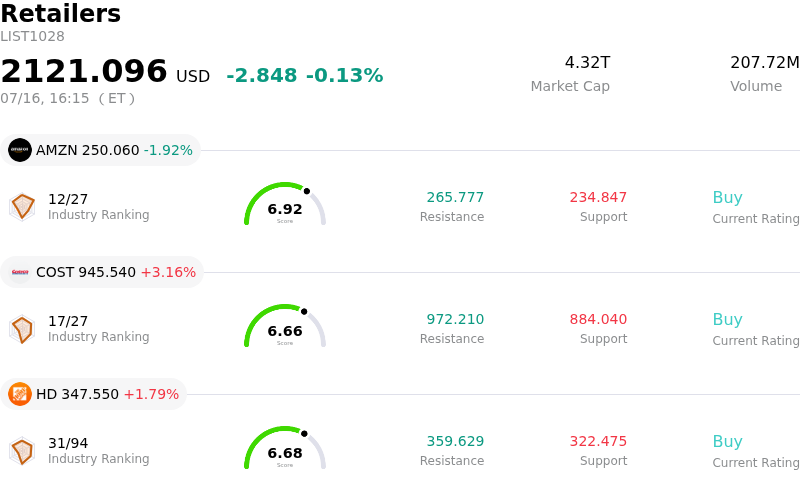
Costco Wholesale Corp (COST) closed up by 3.16%. The Retailers sector is down by 0.13%. The company outperformed the industry. Top 3 stocks by turnover in the sector: Amazon.com Inc (AMZN) down 1.92%; Costco Wholesale Corp (COST) up 3.16%; Home Depot Inc (HD) up 1.79%.
What is driving Costco Wholesale Corp (COST)’s stock price up today?
The positive price action in Costco today reflects a combination of resilient consumer spending data and favorable macroeconomic conditions that benefit large-cap defensive retailers. As broader market volatility persists, institutional investors are rotating back into high-quality names with consistent cash flow and strong membership loyalty. This flight to quality is amplified by recent cooling inflation prints, which suggest that the Federal Reserve may be nearing a transition in monetary policy, thereby lowering the discount rate applied to Costco's premium valuation.
A primary driver for the intraday momentum appears to be the market's reaction to updated retail sales figures that demonstrate the company's ability to drive foot traffic and high renewal rates even in a shifting economic landscape. Furthermore, renewed speculation regarding the timing and impact of membership fee adjustments has provided a significant tailwind. Historically, fee increases have acted as a powerful margin expansion tool, and investors are pricing in the anticipated boost to non-operating income. The company’s continued dominance in the warehouse club space remains a core thesis for long-term holders.
Sentiment has been further bolstered by several prominent brokerage firms maintaining or raising their outlook on the stock. Analysts are increasingly emphasizing the value of Costco's digital transformation efforts and its expanding international footprint as critical growth pillars. The intraday volatility observed likely stems from concentrated institutional buying as the stock clears technical resistance levels, triggering increased algorithmic trading activity. This momentum, coupled with a general lack of selling pressure, has allowed the stock to sustain its gains throughout the trading session.
While the immediate outlook remains bullish, market participants are keeping a close eye on potential logistical costs and wage trends which could impact operational margins in the future. However, Costco’s immense scale and pricing power provide a robust buffer against these risks. As the company moves toward the end of its fiscal period, the current price movement suggests that the market is positioning for continued fundamental strength and a potential upward revision in long-term earnings expectations.
Technical Analysis of Costco Wholesale Corp (COST)
Technically, Costco Wholesale Corp (COST) shows a MACD (12,26,9) value of -2.417, indicating a sell signal. The RSI at 37.609 suggests neutral condition and the Williams %R at 85.108 suggests oversold condition. Please monitor closely.
Media Coverage of Costco Wholesale Corp (COST)
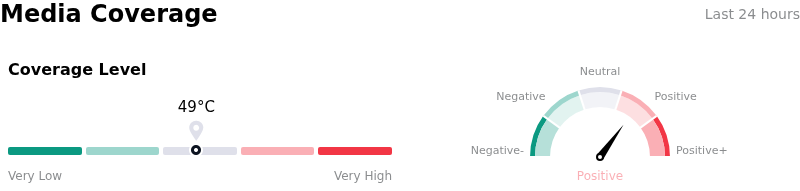
In terms of media coverage, Costco Wholesale Corp (COST) shows a coverage score of 49, indicating a moderate level of media attention. The overall market sentiment index is currently in bullish zone.
Fundamental Analysis of Costco Wholesale Corp (COST)
Costco Wholesale Corp (COST) is in the Retailers industry. Its latest annual revenue is $275.24B, ranking 2 in the industry. The net profit is $8.10B, ranking 2 in the industry. Company Profile
Over the past month, multiple analysts have rated the company as Buy, with an average price target of $1074.98, a high of $1315.00, and a low of $658.22.
More details about Costco Wholesale Corp (COST)
Company Specific Risks:
- Demand Pull-Forward Volatility: Recent September sales data indicates that the 9.3% comparable sales surge was heavily influenced by consumer "panic buying" related to the East Coast port strike and Hurricane Helene; analysts are concerned this represents a temporary pull-forward of demand that will lead to a significant growth vacuum in the subsequent reporting period.
- Valuation Multiple Contraction: Trading at a premium forward price-to-earnings multiple of approximately 50x, the stock is increasingly sensitive to any deviation from perfection; intraday price action reflects institutional "de-risking" as the yield on the stock's growth trajectory struggles to justify such a high valuation relative to historical norms.
- Logistical Backlog Costs: Despite the temporary resolution of the dockworkers' strike, the resulting congestion at major ports is expected to take weeks to clear; the risk of increased "expediting" costs and potential inventory gaps for high-margin seasonal items poses an immediate threat to Q1 margin stability.
- Membership Fee Sensitivity: Following the recent implementation of membership fee increases, investors are closely monitoring renewal rates for signs of consumer attrition; any intraday data suggesting a slowdown in membership growth or a dip in the 90%+ renewal rate could trigger a fundamental re-rating of the company’s primary profit engine.
This article may include AI-generated content that is human-reviewed, which is for reference and general information purposes only and does not constitute investment advice.
Recommended Articles









Comments (0)
Click the $ button, enter the symbol, and select to link a stock, ETF, or other ticker.