


Johnson & Johnson Stock (JNJ) Closed Up by 3.39% on Jul 2: What Investors Need To Know



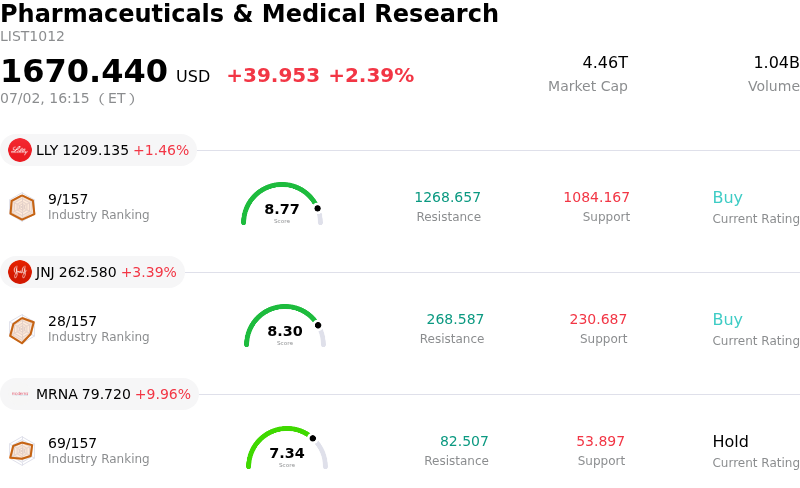
Johnson & Johnson (JNJ) closed up by 3.39%. The Pharmaceuticals & Medical Research sector is up by 2.39%. The company outperformed the industry. Top 3 stocks by turnover in the sector: Eli Lilly and Co (LLY) up 1.46%; Johnson & Johnson (JNJ) up 3.39%; Moderna Inc (MRNA) up 9.96%.
What is driving Johnson & Johnson (JNJ)’s stock price up today?
The upward movement in Johnson & Johnson shares, culminating in a new 52-week high, was driven by a combination of positive pipeline advancements, easing structural risks, and favorable defensive-asset dynamics.
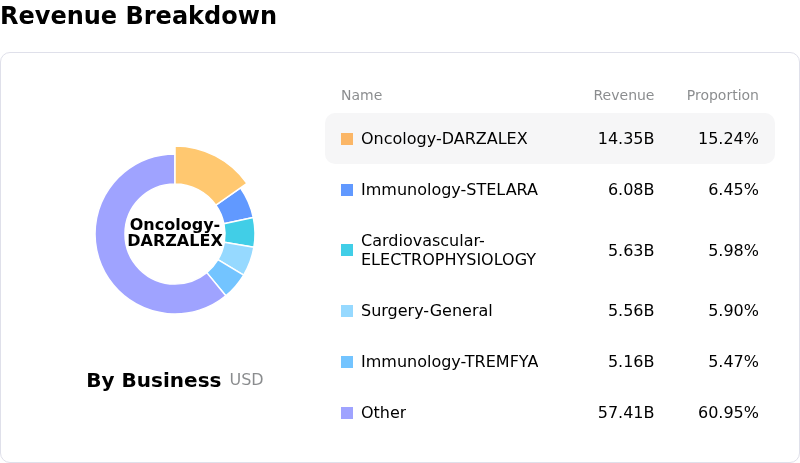
A primary catalyst boosting investor sentiment is the company's aggressive expansion of its high-growth oncology and immunology portfolios. Recent developments have highlighted significant progress in the cancer pipeline, including favorable European regulatory momentum for Tecvayli used in combination with Darzalex. Additionally, the strategic acquisition of Firefly Bio and its proprietary degrader antibody conjugate platform further solidifies the company’s target to generate substantial oncology revenue by the end of the decade. This active pipeline execution successfully reassures Wall Street of the company's ability to counter upcoming patent cliffs and biosimilar erosion affecting older blockbuster therapies.
Simultaneously, a notable easing of the long-standing talc litigation risks has removed a major overhang that previously depressed the stock's valuation. With legal uncertainties moderating, the market has begun to refocus on the company’s robust underlying fundamentals, including its target to hit landmark annual revenue of one hundred billion dollars and achieve double-digit growth by the end of the decade.
Finally, broader market dynamics played a critical role. Following a period where institutional capital heavily favored high-risk technology sectors, defensive rotation returned to solid, high-yield healthcare names. Armed with a pristine balance sheet, strong free cash flows, and an unmatched multi-decade streak of dividend increases, Johnson & Johnson emerged as a primary beneficiary of this institutional safe-haven demand. Increased options trading activity and constructive technical breakouts further accelerated the intraday upward momentum as buyers pushed the stock past key resistance levels.
Technical Analysis of Johnson & Johnson (JNJ)
Technically, Johnson & Johnson (JNJ) shows a MACD (12,26,9) value of 4.386, indicating a buy signal. The RSI at 67.363 suggests neutral condition and the Williams %R at 18.272 suggests overbought condition. Please monitor closely.
Media Coverage of Johnson & Johnson (JNJ)
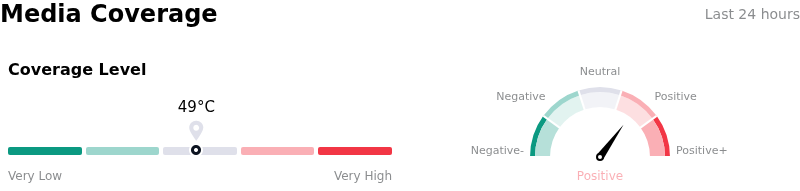
In terms of media coverage, Johnson & Johnson (JNJ) shows a coverage score of 49, indicating a moderate level of media attention. The overall market sentiment index is currently in bullish zone.
Fundamental Analysis of Johnson & Johnson (JNJ)
Johnson & Johnson (JNJ) is in the Pharmaceuticals & Medical Research industry. Its latest annual revenue is $94.19B, ranking 3 in the industry. The net profit is $26.80B, ranking 1 in the industry. Company Profile
Over the past month, multiple analysts have rated the company as Buy, with an average price target of $254.22, a high of $285.00, and a low of $170.00.
More details about Johnson & Johnson (JNJ)
Company Specific Risks:
- Accelerated Stelara Revenue Erosion: Recent market analyst reviews highlight rapid global revenue erosion for J&J's multi-billion-dollar blockbuster, Stelara, as newly approved biosimilars (such as Organon and Samsung Bioepis's Pyzchiva) capture international market share, threatening high-margin segment profitability.
- FTC Antitrust Intervention: J&J faces heightened legal and compliance exposure following the Federal Trade Commission's (FTC) late June 2026 amicus brief in the Fourth Circuit Court of Appeals. The FTC seeks to lower the legal standard required to prove illegal monopolization, directly targeting J&J's patent strategy used to delay low-cost Stelara biosimilars.
- Persistent Talc Litigation Liabilities: J&J remains exposed to catastrophic liabilities across more than 68,000 active multidistrict litigation lawsuits following a Los Angeles jury's recent $32 million mesothelioma verdict against the company, especially as court rejections of mass bankruptcy settlement attempts leave J&J exposed to ongoing individual tort trials.
- Elevated Valuation and Weak Cash Flow: Institutional analysts caution that J&J's premium trailing P/E ratio of over 29x—which is near a two-year high—represents significant overvaluation relative to its single-digit projected earnings growth and weak free cash flow conversion, which sits at only 85% of reported earnings.
This article may include AI-generated content that is human-reviewed, which is for reference and general information purposes only and does not constitute investment advice.
Recommended Articles








Comments (0)
Click the $ button, enter the symbol, and select to link a stock, ETF, or other ticker.