


 Discount


New Zealand Dollar tumbles to 17-year lows as US Dollar hits fresh highs



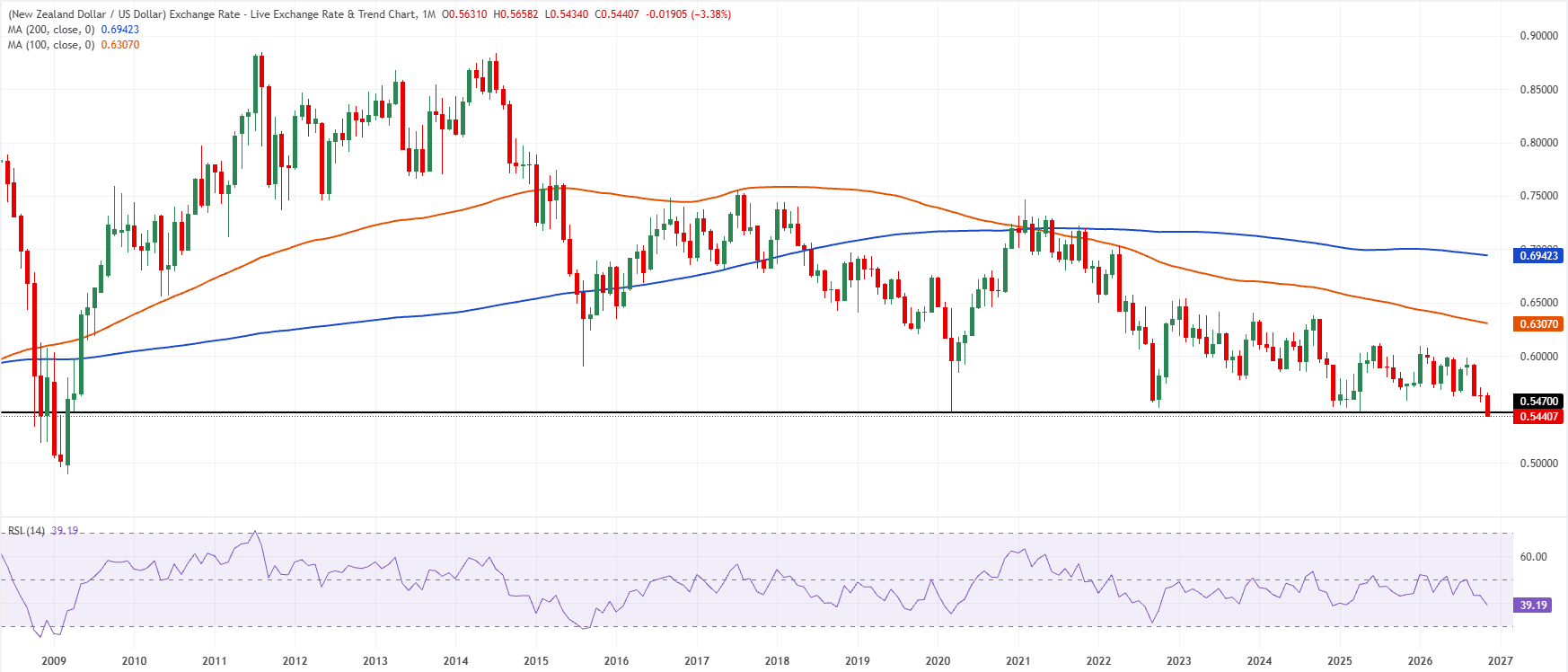
- The New Zealand Dollar falls below 0.5450, reaching its weakest level since 2009.
- Strong New Zealand Retail Sales fail to support the Kiwi amid diverging monetary policy expectations.
- The US Dollar Index reaches a fresh 19-month high as US stocks rebound and economic activity remains resilient.
NZD/USD extends its decline on Monday, losing 0.48% on the day to trade around 0.5440 at the time of writing. The New Zealand Dollar (NZD) fell to its lowest level since 2009 against the US Dollar (USD), breaking below the March 2020 pandemic low near 0.5470 as the Greenback strengthens across the board.
The US Dollar Index (DXY), which measures the Greenback's performance against a basket of six major currencies, climbs to a fresh 19-month high above 104.00, supported by a rebound in US equities and expectations of further monetary tightening by the Federal Reserve (Fed).
Market sentiment improves after Nvidia reinstates Jensen Huang as Chief Executive Officer (CEO), triggering a surge of more than 30% in the company's shares. The rally helps US stocks recover from last week's sell-off and eases concerns surrounding the Artificial Intelligence (AI) sector, a major contributor to US investment and economic growth.
On the economic front, preliminary data from S&P Global show that US business activity continued to expand in November, although at a slower pace. The Composite Purchasing Managers Index (PMI) fell to 54.6 from 55.9 in October, reflecting slower growth in both manufacturing and services.
Meanwhile, expectations of further Fed tightening continue to support the US Dollar. According to the CME FedWatch Tool, markets assign a 96% chance to a 25-basis-point interest rate hike in December, followed by a 62% chance of another increase in January.
On the New Zealand side, the Kiwi fails to benefit from stronger-than-expected domestic consumption data. Statistics New Zealand reported on Monday that Retail Sales increased 2.2% QoQ in the third quarter, significantly exceeding the 0.5% forecast and recovering from a 0.5% contraction in the previous quarter.
Despite the strongest quarterly retail sales growth in nearly five years, the New Zealand Dollar remains under pressure as investors focus on the monetary policy divergence between the Fed and the Reserve Bank of New Zealand (RBNZ).
The RBNZ's decision to leave interest rates unchanged in October, despite expectations of an increase, continues to weigh on the Kiwi. Although markets anticipate a 25-basis-point hike at the December 9 meeting, the prospect has so far failed to reverse the currency's downward momentum.
Looking ahead, investors will focus on Wednesday's release of the US Personal Consumption Expenditures (PCE) Price Index for October, which could provide further clues about the Fed's monetary policy trajectory and influence the next move in NZD/USD.
Recommended Articles









Comments (0)
Click the $ button, enter the symbol, and select to link a stock, ETF, or other ticker.