


 Discount


Australian Dollar gives back some early gains as US Dollar bounces back



- The Australian Dollar gives up half of its early gains against the US Dollar as the latter rebounds.
- Financial markets expect the Fed to deliver back-to-back interest rate hikes.
- Investors await Australia/US inflation data for October.
The Australian Dollar (AUD) surrenders some of its early gains against the US Dollar (USD) on Monday. The Aussie pair retreats from its day’s high of 0.6657 as the US Dollar bounces back, but is still 0.32% higher at around 0.6638 in the European trade.
In the European trade, the US Dollar Index (DXY), which gauges the Greenback’s value against six major currencies, recovers its early losses and turns marginally positive at around 103.89.
The outlook of the US Dollar was already upbeat as financial markets are confident that the Federal Reserve (Fed) will deliver a series of interest rate hikes in the near term.
TD Securities looks for three straight Fed hikes as resilient US data keeps pressure on inflation
According to TD Securities, “most officials would support consecutive 25bp hikes in December and January,” with the bank also looking for “a third hike in March.” The economists note that “data last week and our expectations for data this week are in line with recent trends,” arguing that “inflation remains above target and is moving in the wrong direction.” At the same time, they point out that “the labor market has stabilized, with some signs of strengthening, and activity data has been robust.” In their view, “the economy can handle more restriction, and the Fed is likely to provide it,” with “the evolution of inflation data” set to determine “the extent and pace of hikes later in the cycle.”
For more cues about the Fed’s monetary policy outlook, investors await the United States (US) Personal Consumption Expenditure (PCE) Price Index data for October, which is scheduled for Wednesday.
TD Securities said lingering supply-side frictions and sector-specific forces are likely to keep price pressures elevated for longer. The bank argues that “with supply chains still stressed amid AI-led price pressures, we do not see room for inflation progress in the near-term,” and projects that “core CPI inflation [will] be 2.9% y/y in Q4 2026, higher than the end of 2025, while the core PCE version should end the year firmer.” TD Securities also expects that “most of the impact of higher oil prices will filter into headline inflation,” delaying the return to target-consistent outcomes. In their view, only “gradual disinflation” is likely to “resume by the middle of 2027.”
On the Australian Dollar front, traders await Consumer Price Index (CPI) data for October, which is also scheduled for Wednesday.
The inflation data is expected to come in at 4.8% Year-on-Year (YoY), higher than the previous reading of 4.3%. The data will likely have a significant impact of Reserve Bank of Australia’s (RBA) interest rate expectations.
AUD/USD Technical Analysis
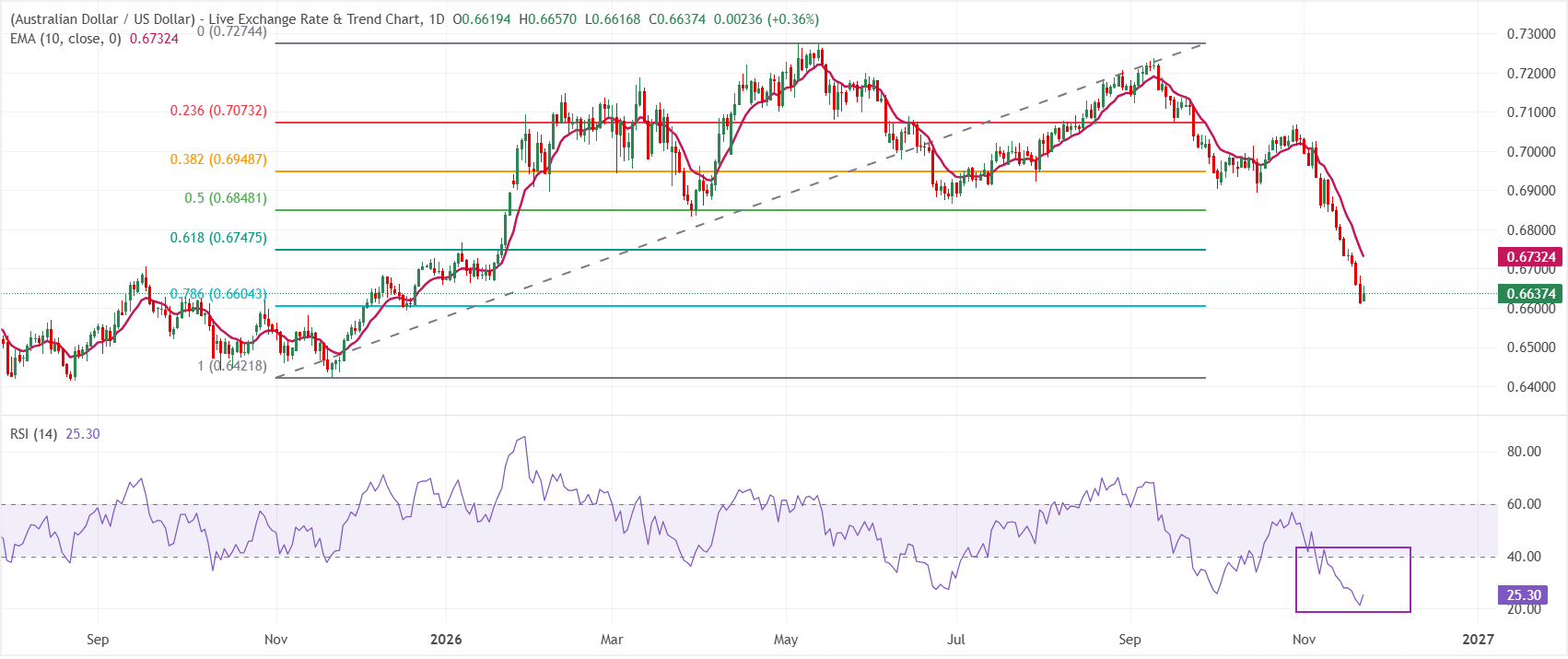
In the daily chart, AUD/USD trades at 0.6638, extending a clear bearish bias as spot holds below the 10-day exponential moving average (EMA) at 0.6732 and all nearby Fibonacci retracements. The Relative Strength Index (14) hovers in oversold territory near 25, hinting that while downside momentum remains heavy, the pace of the recent slide could start to moderate on approach to deeper supports.
On the downside, initial support is aligned with the 78.6% Fibonacci retracement at 0.6604, ahead of a more substantial structural floor at the 100% retracement near 0.6422. On the topside, the 10-day EMA at 0.6732 is immediate resistance, followed by the 61.8% retracement at 0.6748, with further hurdles then seen at the 50% level around 0.6848 and higher Fibonacci barriers at 0.6949 and 0.7073.
(The technical analysis of this story was written with the help of an AI tool. Know more.)
Economic Indicator
Consumer Price Index (YoY)
The Consumer Price Index (CPI), released by the Australian Bureau of Statistics on a monthly basis, measures the changes in the price of a comprehensive basket of goods and services acquired by household consumers. The indicator is the primary measure of headline inflation after a new methodology was applied to transition from quarterly to monthly readings, applying to data from April 2024 onwards. The YoY reading compares prices in the reference month to the same month a year earlier. A high reading is seen as bullish for the Australian Dollar (AUD), while a low reading is seen as bearish.
Next release: Wed Nov 25, 2026 00:30
Frequency: Monthly
Consensus: 4.8%
Previous: 4.3%
Source: Australian Bureau of Statistics
Recommended Articles









Comments (0)
Click the $ button, enter the symbol, and select to link a stock, ETF, or other ticker.