


USD/CAD Price Forecast: Uptrend stays intact as RSI nears overbought territory



- USD/CAD pulls back from its highest level since April 7.
- Technically, bullish momentum persists as RSI climbs toward overbought territory.
- Traders await US and Canadian employment data due on Friday.
The Canadian Dollar (CAD) recovers some ground against the US Dollar (USD) on Thursday, with USD/CAD reversing earlier gains as traders weigh a softer Greenback against lower Crude Oil prices. At the time of writing, the pair is trading around 1.3895 after pulling back from an intraday high of 1.3925, its highest level since April 7.
The US Dollar is under modest pressure as market sentiment improves following a ceasefire agreement between Israel and Lebanon, raising hopes that US-Iran peace talks could regain momentum after showing little progress in recent days.
Oil prices have also retreated on the latest optimism. West Texas Intermediate (WTI) Crude Oil is down more than 3% on the day after posting gains for three consecutive days. The Canadian Dollar is highly sensitive to Oil price movements, given Canada's status as a major crude exporter.
Softer Oil prices could limit deeper follow-through selling in USD/CAD, while traders also avoid placing aggressive directional bets ahead of key employment reports from the United States and Canada due on Friday.
In the United States, economists expect Nonfarm Payrolls (NFP) to show the economy added 85K jobs in May, down from 115K in April, while the Unemployment Rate is forecast to remain unchanged at 4.3%.
In Canada, employment is expected to increase by 10K after a decline of 17.7K in April, with the Unemployment Rate seen holding steady at 6.9%
Technical Analysis:
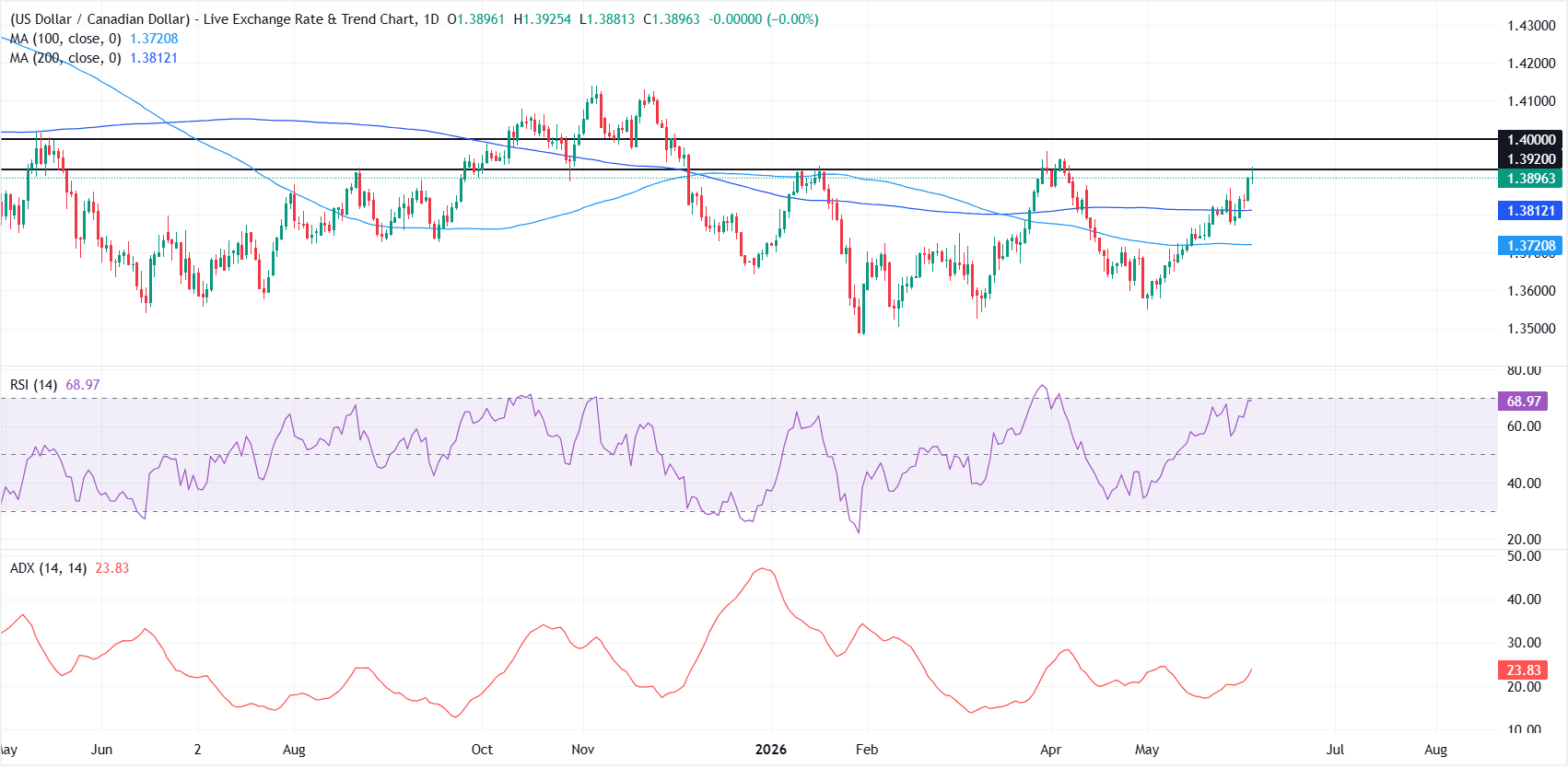
On the daily chart, USD/CAD holds well above the 200-day Simple Moving Average (SMA) at 1.3812 and the 100-day SMA at 1.3721, which underpins a constructive near-term bias.
The Relative Strength Index (RSI) holds near 68, approaching overbought territory, while the Average Directional Index (ADX) around 24 suggests a moderate, strengthening trend as the pair grinds higher toward nearby overhead barriers.
On the topside, initial resistance emerges at the recent horizontal cap around 1.3920, with a subsequent hurdle at the psychological 1.4000 level, where further selling interest could build if momentum cools.
On the downside, any pullback is likely to find first support at the 200-day SMA near 1.3812, with the 100-day SMA around 1.3721 acting as a deeper safety net while the broader bullish structure remains intact above these averages.
(The technical analysis of this story was written with the help of an AI tool.)
Employment FAQs
Labor market conditions are a key element to assess the health of an economy and thus a key driver for currency valuation. High employment, or low unemployment, has positive implications for consumer spending and thus economic growth, boosting the value of the local currency. Moreover, a very tight labor market – a situation in which there is a shortage of workers to fill open positions – can also have implications on inflation levels and thus monetary policy as low labor supply and high demand leads to higher wages.
The pace at which salaries are growing in an economy is key for policymakers. High wage growth means that households have more money to spend, usually leading to price increases in consumer goods. In contrast to more volatile sources of inflation such as energy prices, wage growth is seen as a key component of underlying and persisting inflation as salary increases are unlikely to be undone. Central banks around the world pay close attention to wage growth data when deciding on monetary policy.
The weight that each central bank assigns to labor market conditions depends on its objectives. Some central banks explicitly have mandates related to the labor market beyond controlling inflation levels. The US Federal Reserve (Fed), for example, has the dual mandate of promoting maximum employment and stable prices. Meanwhile, the European Central Bank’s (ECB) sole mandate is to keep inflation under control. Still, and despite whatever mandates they have, labor market conditions are an important factor for policymakers given its significance as a gauge of the health of the economy and their direct relationship to inflation.
Recommended Articles







Comments (0)
Click the $ button, enter the symbol, and select to link a stock, ETF, or other ticker.