


Elorian’s Glimpse bets image-first reasoning can undercut bigger AI models



Elorian launched Glimpse on October 16, claiming that its visual reasoning can compete with larger AI models for a fraction of the price.
According to TechCrunch, the initial model is a research preview that includes developer API access and a waitlist for its chat interface. For companies that are thinking of trying this technology, an actual challenge is whether Glimpse is able to give similar performance in real-world situations.
The visual scratch space pitch
In contrast to the models that analyze images first before drawing conclusions mainly in text, Glimpse can go back to visual evidence, look closer into details, inspect video frames, and run any codes. The company calls this its “visual scratch space.”
Andrew Dai, the CEO of Elorian and an ex-researcher at Google DeepMind, shared a story where he asked his AI model to determine the winner in the board game he played. The AI was unable to decode the meanings of the different games symbols, which humans had no trouble in understanding.
Humans can look at Ikea diagrams, with no text, and assemble Ikea furniture, right? Why can’t AI models?
— Andrew Dai, speaking to TechCrunch
The concept has been previously applied. OpenAI launched crop-and-zoom logic in 2025. The CharTool research paper, which was updated in August 2026, combined image cropping with code-based calculations. In the case of Elorian, an open-weights base is used, along with only a few hundred of GPUs during implementation.
Numbers Elorian reports, and the ones it does not emphasize
Glimpse’s pricing is $0.60 for every million input tokens and $3 for every million output , reportedly 94% lower than what Astra charges. Elorian previously raised capital amounting to $55 million with a valuation of $300 million, with investors including Nvidia and Google’s chief scientist Jeff Dean.
According to Elorian’s report, Glimpse has outperformed GPT-6 Astra in some aspects including CharXiv-R (92.90 versus 92.10), short-form video captioning, open-vocabulary counting, and manipulation-event understanding. Also, both systems yielded identical results in embodied spatial reasoning.
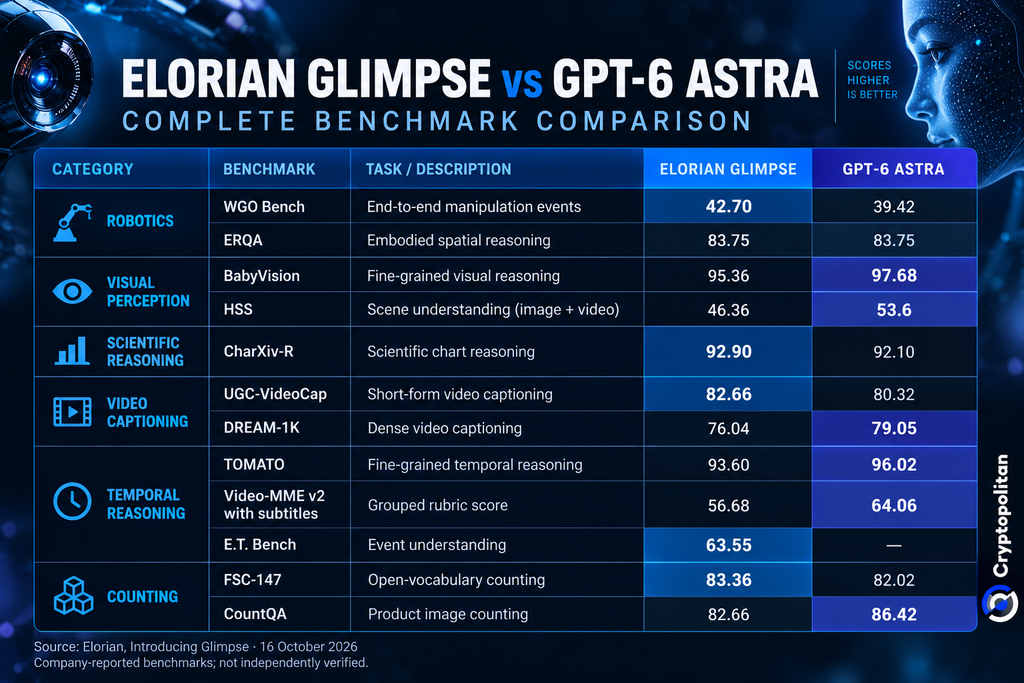
However, Glimpse has lost to Astra in dense video captioning, fine-grained temporal reasoning, and product-image counting. Moreover, when it comes to the HSS (Elorian’s benchmark related to understanding the scenes), Glimpse’s score is 46.36, while the score of Astra is 53.6. The human baseline is 93.1%. The comparison of Glimpse with Astra has not been independently verified yet.
Where today’s models actually fail
Independent research shows why accuracy matters. RoboVista, from Berkeley, Princeton and Google DeepMind, found its strongest model answered just 56.5% of 474 robot-related questions correctly.
Meanwhile, InspecSafe-V1 collected 5,013 inspection instances from 41 robots across 2,239 sites. The research highlights real-world challenges including glare, occlusion and sensor noise. A separate chart study likewise identifies fine-grained visual perception as a persistent weakness.
A large market, if the accuracy holds
The International Federation of Robotics reported that around 5 million industrial robots were operating worldwide in 2025, up 9% from the previous year. More than 600,000 new robots were installed, highlighting the growing need for machines that can understand and respond to their surroundings.
That demand is also driving investment in robot training. As Cryptopolitan reported, LG is using Nvidia’s tools to collect 100,000 hours of robot training data by the end of 2026, ahead of a planned humanoid demonstration in early 2027. Although the project has no connection to Elorian, it shows how important visual understanding is becoming in robotics.
Elorian hopes to eventually move beyond visual reasoning to direct robot control, a capability Glimpse does not yet offer. For now, convincing businesses to adopt the model will depend on how accurately and safely it performs in real-world conditions, how easily it integrates with existing systems, and whether its costs remain competitive. Strong benchmark scores alone will not be enough.
If you're reading this, you’re already ahead. Stay there with our newsletter.
Recommended Articles






Comments (0)
Click the $ button, enter the symbol, and select to link a stock, ETF, or other ticker.