


Gold rallies above $4,100 as NASDAQ 100 crashes, December hike bets fade



- Gold gains 1% above $4,100 as NASDAQ 100 plunges 5.9%.
- US 10-year Treasury yields fall six basis points to 4.829%.
- December Fed hike odds tumble to 66% from 82% ahead of NFP.
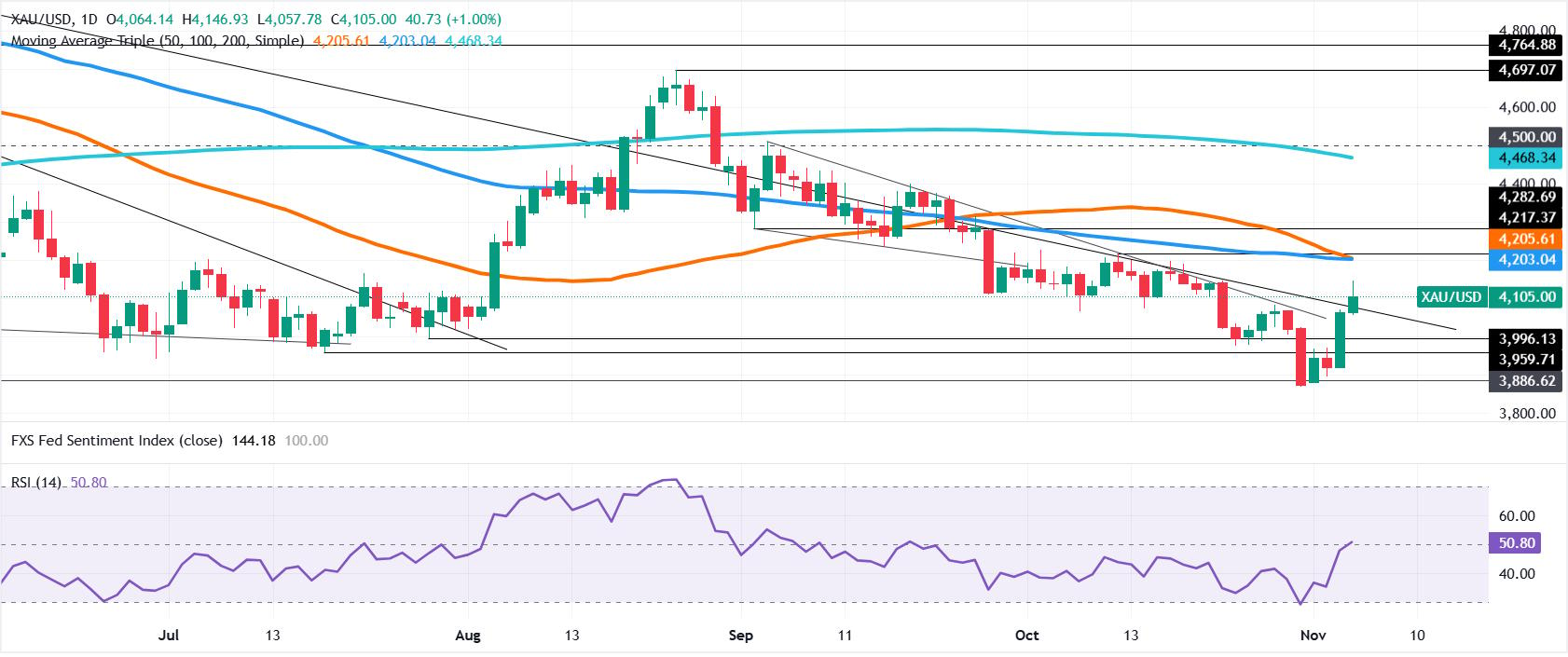
Gold (XAU/USD) climbs some 1% on Thursday as the Greenback edges lower amid solid US data and hawkish comments by Federal Reserve (Fed) officials. The XAU/USD trades above $4,100 after bouncing off daily lows of $4,057.
Bullion advances amid brutal tech sell-off, falling Treasury yields
Risk appetite soured as the NASDAQ100 plummeted nearly 5.9% in a bloodbath, with investors rotating from tech stocks to defensive ones. The other two US indices, the Dow Jones and the S&P 500, each tumbled by 2.9% and 3.8%, respectively, in the aftermath of the Democratic landslide victory in the US midterm elections.
The US Dollar Index (DXY), which tracks the buck’s performance against a basket of six currencies, is virtually unchanged at 101.46, after recovering from a daily low at of 101.19.
US jobs data was solid, which could be a prelude of Friday’s Nonfarm Payrolls report. Initial Jobless Claims for the week ending October 31 dipped from 195K to 189K, below forecasts of 196K. Earlier, the firm Challenger, Grey and Christmas reported that job cuts for October increased just 2%, from 43,281 to 43,994, noting that the uptick in inflation is minimal, while companies announced plans to hire over 444,692 workers last month, up 57% compared to 2025 figures.
Federal Reserve (Fed) officials crossed the wires. Cleveland Fed President Beth Hammack said she favors a gradual approach to rate increases and that the Fed still has more work to do. Meanwhile, Richmond Fed President Thomas Barkin said “broad-based” inflation remains too high, echoing Hammack's call for a gradual approach.
In the meantime, US Treasury yields are falling amid lower inflation expectations as Oil prices retreat from pre-election highs. The US 10-year Treasury note is yielding 4.829%, down six basis points.
Consequently, traders continue to shrink their hawkish bets as they see a 66% chance that the Fed will raise rates by 25 basis points at the December meeting, down from 82% odds a day ago, according to CME's FedWatch Tool.
Gold traders are focused on October’s Nonfarm Payrolls (NFP) figures, which are expected to rise to 65K up from 29K in the prior’s month. Additionally, the Unemployment Rate is expected to stay unchanged at 2.9%.
XAU/USD technical outlook: Gold extends its gains above $4,100
At the time of writing, Gold is clearing a key resistance trendline after claiming the $4,100 psychological figure. Momentum is tilted to the upside as the Relative Strength Index (RSI) turns bullish, which could pave the way for further upside.
Nevertheless, from a market structure perspective, XAU/USD remains tilted to the downside. However, if buyers reclaim the confluence of the 100-day and 50-day Simple Moving Averages (SMAs), each at $4,203 and $4,205, respectively, this can open the door to challenge $4,300. A move past the latter opens the path toward the 200-day SMA at $4,468.
For a bearish continuation, Gold must drop below $4,100. If losses extend past $4,000, the next stop is the November 4 daily low of $3,919. Below, the next line of defense for bulls is the October 30 year-to-date low at $3,879 and the April 22, 2025, daily high-turned-support at $3,500.
Gold FAQs
Gold has played a key role in human’s history as it has been widely used as a store of value and medium of exchange. Currently, apart from its shine and usage for jewelry, the precious metal is widely seen as a safe-haven asset, meaning that it is considered a good investment during turbulent times. Gold is also widely seen as a hedge against inflation and against depreciating currencies as it doesn’t rely on any specific issuer or government.
Central banks are the biggest Gold holders. In their aim to support their currencies in turbulent times, central banks tend to diversify their reserves and buy Gold to improve the perceived strength of the economy and the currency. High Gold reserves can be a source of trust for a country’s solvency. Central banks added 1,136 tonnes of Gold worth around $70 billion to their reserves in 2022, according to data from the World Gold Council. This is the highest yearly purchase since records began. Central banks from emerging economies such as China, India and Turkey are quickly increasing their Gold reserves.
Gold has an inverse correlation with the US Dollar and US Treasuries, which are both major reserve and safe-haven assets. When the Dollar depreciates, Gold tends to rise, enabling investors and central banks to diversify their assets in turbulent times. Gold is also inversely correlated with risk assets. A rally in the stock market tends to weaken Gold price, while sell-offs in riskier markets tend to favor the precious metal.
The price can move due to a wide range of factors. Geopolitical instability or fears of a deep recession can quickly make Gold price escalate due to its safe-haven status. As a yield-less asset, Gold tends to rise with lower interest rates, while higher cost of money usually weighs down on the yellow metal. Still, most moves depend on how the US Dollar (USD) behaves as the asset is priced in dollars (XAU/USD). A strong Dollar tends to keep the price of Gold controlled, whereas a weaker Dollar is likely to push Gold prices up.
Recommended Articles







Comments (0)
Click the $ button, enter the symbol, and select to link a stock, ETF, or other ticker.