


Gold slides as Warsh hawkish tilt lifts US Dollar and US yields


- Gold drops below $4,600 as Warsh prioritizes inflation fight.
- Dollar and yields rise as Fed hike odds increase.
- September risks ease slightly, but December tightening bets climb.
Gold price drops over 0.42% on Friday as Fed Chair Kevin Warsh confirms the Fed is focused on tackling inflation, pushing the US Dollar and US Treasury yields higher, while money markets have begun to price in a potential rate hike in 2026. The XAU/USD trades at $4,576 after diving below $4,600 and refreshing weekly lows of $4,530.
XAU/USD falls below $4,600 as Fed hike bets rise after Jackson Hole
In Jackson Hole, Warsh revealed that he still sees inflation as a priority, leaning hawkish as he recognised that underlying measures of inflation haven’t improved. He stated that the US central bank must be confident that inflation is returning to its 2% goal, or otherwise “we have work to do.”
In his prepared remarks, he acknowledged that consumer spending is healthy and that the labour market is solid. Nevertheless, when speaking about price stability, Warsh recognised that the figures are “more concerning,” hinting that the Fed would focus on tackling inflation.
Immediately after his remarks, money markets priced in a 50% chance of a 25-basis-point rate hike by the Fed at the September 16 meeting. As of writing, investors trimmed the odds to nearly 44%, but for December, they see a 82% chance, according to Prime Terminal.
The Greenback rose by over 0.38%, as measured by the US Dollar Index (DXY), which tracks the value of the American currency against six other currencies. The DXY sits ate 99.49, underpinned by the jump in US Treasury yields. The US 10-year Treasury yield has risen 1.5 basis points up at 4.686%.
XAU/USD technical analysis: Gold’s poised for further downside, below $4,600
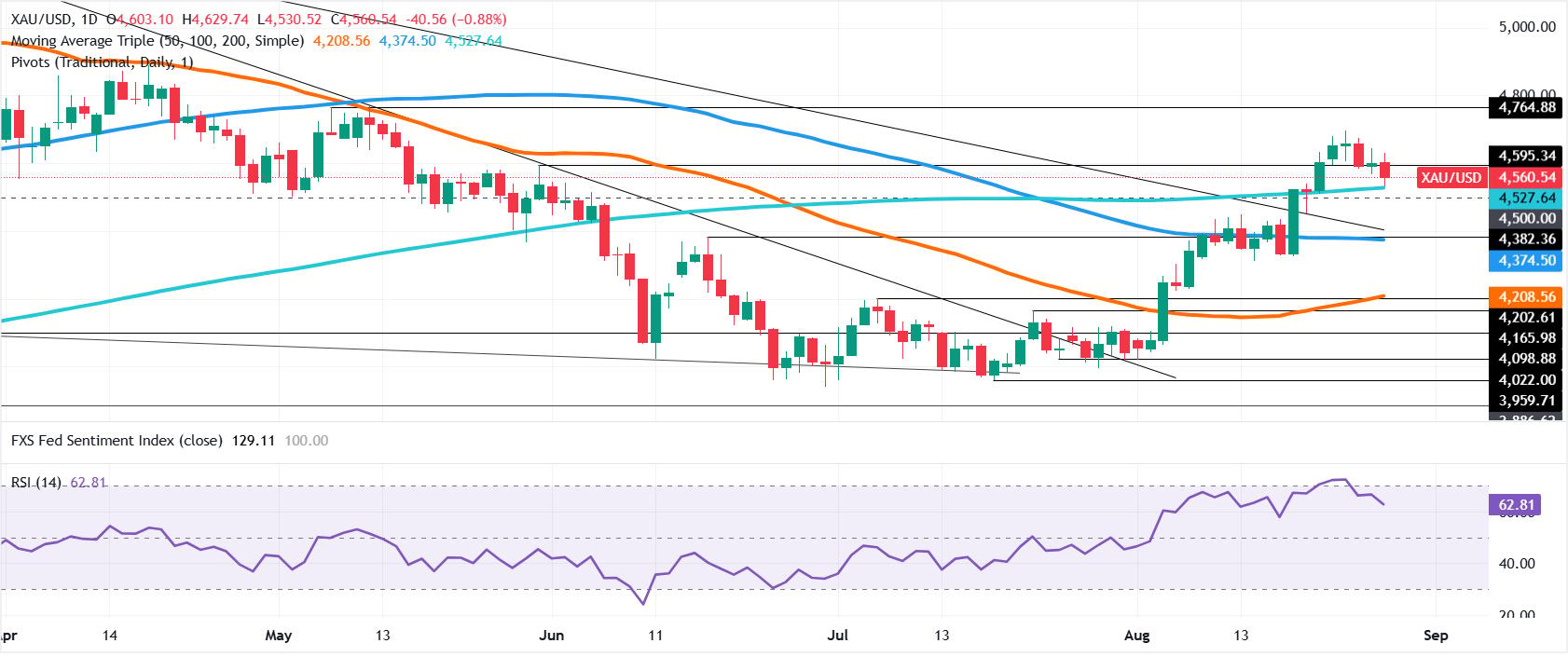
Gold’s price action showed that the yellow metal “almost” tested the 200-day Simple Moving Average (SMA) at $4,527, though it reversed part of the move on Warren’s remarks, pushing back above the psychological $4,550 area.
From a momentum standpoint, buyers remain in charge as the RSI is above its 50-level. Nevertheless, recently the index is aiming lower, an indication that in the short-term, sellers are stepping in.
If XAU/USD drops below the 200-day SMA, it could open the door to a move toward $4,500. Below is the 100-day SMA at $4,374, the next area of interest.
For buyers, the next stop in Gold’s recovery is $4,600. A decisive breakout could open the door to challenge the August 27 daily high at $4,643 ahead of the elusive $4,700.
Gold FAQs
Gold has played a key role in human’s history as it has been widely used as a store of value and medium of exchange. Currently, apart from its shine and usage for jewelry, the precious metal is widely seen as a safe-haven asset, meaning that it is considered a good investment during turbulent times. Gold is also widely seen as a hedge against inflation and against depreciating currencies as it doesn’t rely on any specific issuer or government.
Central banks are the biggest Gold holders. In their aim to support their currencies in turbulent times, central banks tend to diversify their reserves and buy Gold to improve the perceived strength of the economy and the currency. High Gold reserves can be a source of trust for a country’s solvency. Central banks added 1,136 tonnes of Gold worth around $70 billion to their reserves in 2022, according to data from the World Gold Council. This is the highest yearly purchase since records began. Central banks from emerging economies such as China, India and Turkey are quickly increasing their Gold reserves.
Gold has an inverse correlation with the US Dollar and US Treasuries, which are both major reserve and safe-haven assets. When the Dollar depreciates, Gold tends to rise, enabling investors and central banks to diversify their assets in turbulent times. Gold is also inversely correlated with risk assets. A rally in the stock market tends to weaken Gold price, while sell-offs in riskier markets tend to favor the precious metal.
The price can move due to a wide range of factors. Geopolitical instability or fears of a deep recession can quickly make Gold price escalate due to its safe-haven status. As a yield-less asset, Gold tends to rise with lower interest rates, while higher cost of money usually weighs down on the yellow metal. Still, most moves depend on how the US Dollar (USD) behaves as the asset is priced in dollars (XAU/USD). A strong Dollar tends to keep the price of Gold controlled, whereas a weaker Dollar is likely to push Gold prices up.
Recommended Articles







Comments (0)
Click the $ button, enter the symbol, and select to link a stock, ETF, or other ticker.