


Gold slides as US yields surge, keeping $4,100 out of reach



- Gold falls as soaring Treasury yields offset softer Dollar backdrop
- Fed dissenters defend hikes, keeping inflation risks in focus
- Failure below $4,100 exposes downside as WTI remains elevated
Gold price tumbles nearly 1.50% on Friday as the US Dollar recovers some ground after Japanese authorities intervened in the foreign exchange markets a day ago, driving the Greenback to a 30-day low before recovering, according to the US Dollar Index (DXY). The XAU/USD trades at $4,045.
XAU/USD drops as Treasury yields, Fed dissents and inflation risks pressure Bullion
The yellow metal is poised to finish the week with losses of over 0.11%, unable to decisively crack the $4,100 milestone. At the same time, the DXY, which tracks the performance of the buck’s value against six currencies, is down 0.05%, at 99.91, but failed to provide a tailwind for Gold prices as US Treasury yields are soaring.
The US 10-year Treasury note is yielding 4.745%, up almost seven and a half basis points, as investors assess whether the Federal Reserve (Fed) will raise rates to tame inflation.
On Thursday, US economic data showed that economic growth was softer than projected in Q2 2025, down from 2.1% in Q1 to 1.5% QoQ. The Fed’s preferred inflation gauge, the Core Personal Consumption Expenditures (PCE) Price Index, came in at 3.3% YoY, down from 3.4%, a relief for the US central bank, which decided to keep rates unchanged on Wednesday.
During the day, three FOMC members who voted for rate hikes revealed the reasons for their vote.
Dallas Fed's Lorie Logan suggested that inflation risks are tilting upward and favored raising interest rates to improve the balance of the outlook. Beth Hammack from the Cleveland Fed mentioned that the policy rate is still not restrictive enough as inflation has been “too high for too long. The Minneapolis Fed's Neel Kashkari said he preferred to raise rates by 25 basis points as he favors a gradual approach to monetary policy rather than “bolder actions.”
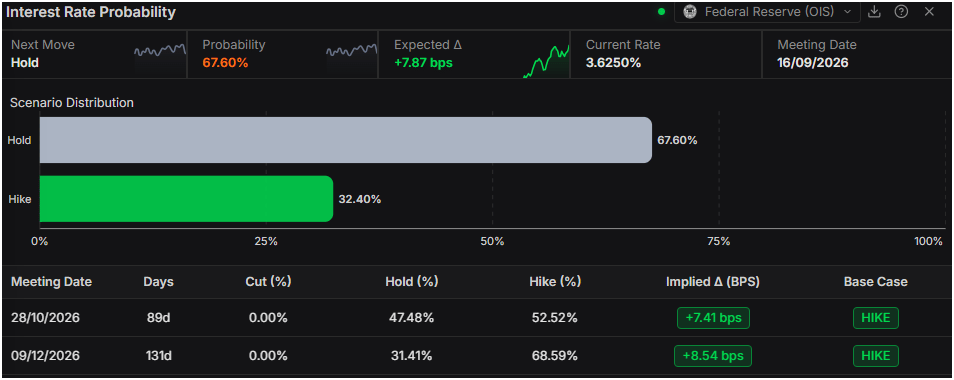
Money markets trimmed hawkish bets after the July meeting. Before, the odds for a rate hike in September were nearly 60%. As of writing, the chances were trimmed to 31%, with the odds for a hold increasing near 70%, according to Prime Terminal data.
US economic data showed that consumers are becoming optimistic about the economic outlook. The University of Michigan Consumer Sentiment for July improved from its preliminary reading of 54.4 to 55.2. At the same time, inflation expectations remained unchanged at 4.2% for one year and 3.3% for five years.
Joanne Hsu, the Director of the Survey of Consumers, wrote, “Broad-based improvements were seen across all groups by income, education, wealth, age, and political party.”
Aside from this, geopolitics continued to play a role in the financial markets. Rising Oil prices are a headwind for Bullion. The escalation of the Gulf War keeps the US crude benchmark, West Texas Intermediate (WTI), above $84.00 per barrel
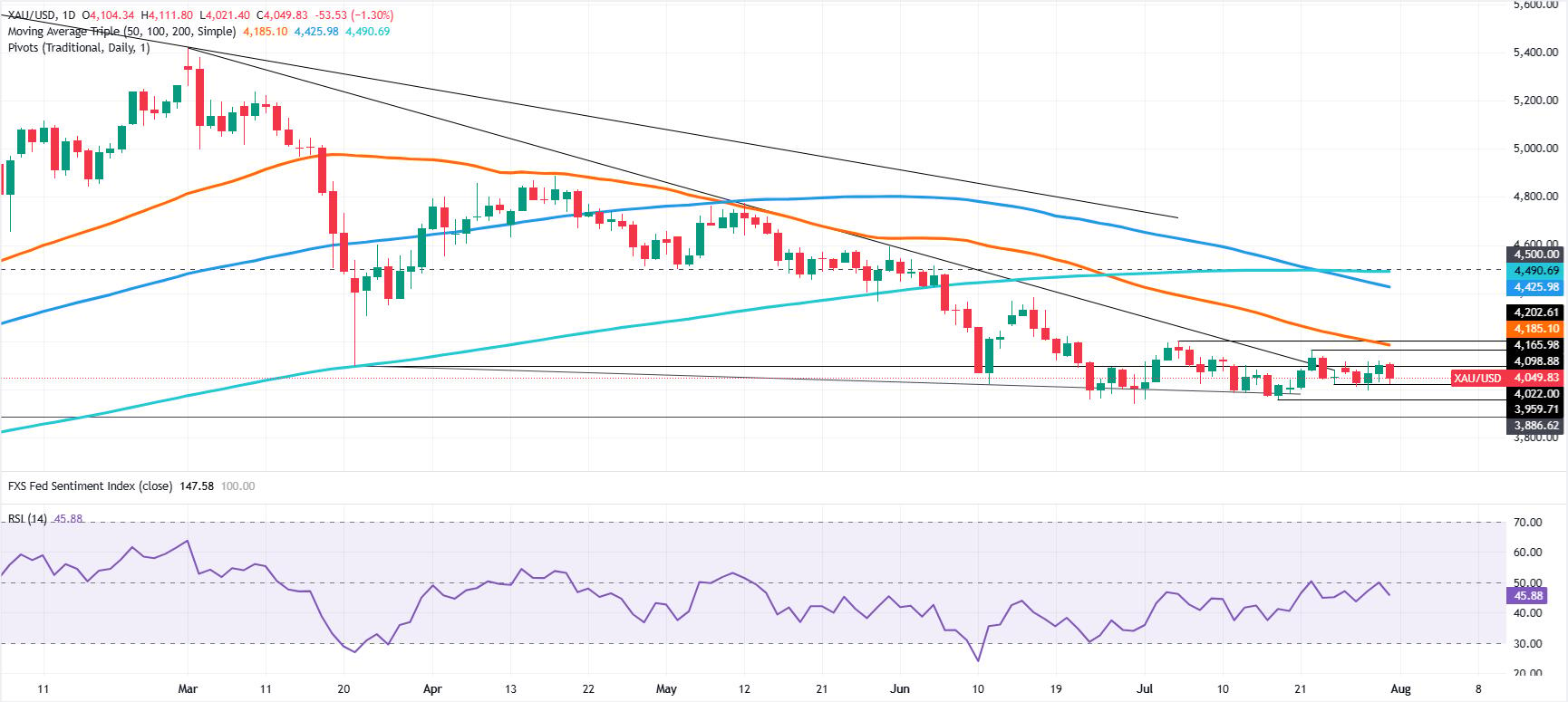
XAU/USD technical outlook: Gold retraces below $4,050, eyes on $4,000
Gold’s price shifted downwards steadily after two days of strong gains, and sits below the $4,100 level. The momentum shifted back bearishly as the Relative Strength Index (RSI) crossed under 50, signaling decreasing buying interest.
On the downside, initial support is at the July 24 low of $4,022. A breach of the latter exposes the psychologically important $4,000 level and the June 17 daily low of $3,959.
For a bullish continuation, buyers need to reclaim $4,100, ahead of the July 22 daily high of $4,165, potentially testing the 50-day Simple Moving Average at $4,185. The July 6 peak at $4,202 is the next resistance level.
Gold FAQs
Gold has played a key role in human’s history as it has been widely used as a store of value and medium of exchange. Currently, apart from its shine and usage for jewelry, the precious metal is widely seen as a safe-haven asset, meaning that it is considered a good investment during turbulent times. Gold is also widely seen as a hedge against inflation and against depreciating currencies as it doesn’t rely on any specific issuer or government.
Central banks are the biggest Gold holders. In their aim to support their currencies in turbulent times, central banks tend to diversify their reserves and buy Gold to improve the perceived strength of the economy and the currency. High Gold reserves can be a source of trust for a country’s solvency. Central banks added 1,136 tonnes of Gold worth around $70 billion to their reserves in 2022, according to data from the World Gold Council. This is the highest yearly purchase since records began. Central banks from emerging economies such as China, India and Turkey are quickly increasing their Gold reserves.
Gold has an inverse correlation with the US Dollar and US Treasuries, which are both major reserve and safe-haven assets. When the Dollar depreciates, Gold tends to rise, enabling investors and central banks to diversify their assets in turbulent times. Gold is also inversely correlated with risk assets. A rally in the stock market tends to weaken Gold price, while sell-offs in riskier markets tend to favor the precious metal.
The price can move due to a wide range of factors. Geopolitical instability or fears of a deep recession can quickly make Gold price escalate due to its safe-haven status. As a yield-less asset, Gold tends to rise with lower interest rates, while higher cost of money usually weighs down on the yellow metal. Still, most moves depend on how the US Dollar (USD) behaves as the asset is priced in dollars (XAU/USD). A strong Dollar tends to keep the price of Gold controlled, whereas a weaker Dollar is likely to push Gold prices up.
Recommended Articles









Comments (0)
Click the $ button, enter the symbol, and select to link a stock, ETF, or other ticker.