HSBC Holdings PLC Stock (HSBC) Opened Down by 3.80% on Mar 12: What Investors Need To Know



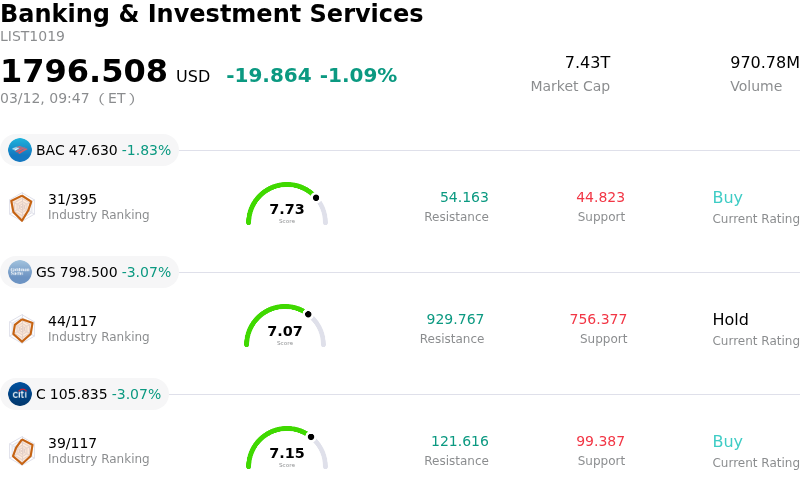
HSBC Holdings PLC (HSBC) opened down by 3.80%. The Banking & Investment Services sector is down by 1.09%. The company underperformed the industry. Top 3 stocks by turnover in the sector: Bank of America Corp (BAC) down 1.83%; Goldman Sachs Group Inc (GS) down 3.07%; Citigroup Inc (C) down 3.07%.
What is driving HSBC Holdings PLC (HSBC)’s stock price down today?
HSBC's share price decline reflects a confluence of factors, including geopolitical uncertainties and adjustments in its internal reporting structure. The bank, alongside others, has placed certain Middle Eastern transactions on hold and is considering shifting focus to more stable markets due to ongoing geopolitical tensions. This development can create investor apprehension regarding potential impacts on its international operations and revenue streams.
Compounding investor concerns are previously noted company-specific risks. These include a temporary suspension of share buybacks, driven by a dip in the CET1 capital ratio below its target range following an acquisition. Additionally, ongoing legal provisions and regulatory scrutiny regarding data practices and risk management continue to highlight potential vulnerabilities for the bank.
Furthermore, HSBC recently announced changes to its business segment reporting structure, effective from January 1, 2026. While the bank has stated these changes, which involve reclassifying certain clients primarily from its Hong Kong and UK segments to Corporate and Institutional Banking, do not alter its consolidated financial results or position, they introduce a re-presented view of past financial information. Such re-segmentation, particularly ahead of the first-quarter 2026 earnings release, can introduce a degree of uncertainty for investors as they recalibrate their understanding of the bank's performance metrics and segment contributions.
The broader UK banking sector is also navigating new regulatory protocols impacting cash withdrawals and account monitoring, particularly for customers over 60, aimed at combating financial fraud. These changes, which include "soft limits" on ATM withdrawals and stricter in-branch verification, could contribute to an evolving operational landscape for UK-based financial institutions.
Technical Analysis of HSBC Holdings PLC (HSBC)
Technically, HSBC Holdings PLC (HSBC) shows a MACD (12,26,9) value of [0.69], indicating a neutral signal. The RSI at 47.40 suggests neutral condition and the Williams %R at -71.31 suggests oversold condition. Please monitor closely.
Fundamental Analysis of HSBC Holdings PLC (HSBC)
HSBC Holdings PLC (HSBC) is in the Banking & Investment Services industry. Its latest annual revenue is $69.62B, ranking 4 in the industry. The net profit is $21.10B, ranking 3 in the industry. Company Profile
Over the past month, multiple analysts have rated the company as Strong Buy, with an average price target of $101.25, a high of $101.25, and a low of $101.25.
More details about HSBC Holdings PLC (HSBC)
Company Specific Risks:
- HSBC is identified as one of the European banks most exposed to the Middle East conflict, according to J.P. Morgan, introducing significant geopolitical risk to its global operations.
- The bank reported a 7% drop in full-year pre-tax profit, driven by US$4.9 billion in one-off charges including write-offs related to its Chinese holdings and substantial legal provisions.
- HSBC has paused its share buyback program for three quarters to finance the acquisition of Hang Seng Bank, which may negatively impact shareholder returns and market sentiment.
- Changes to HSBC's reporting structure, effective January 1, 2026, concerning client transitions between business segments, could lead to short-term challenges in financial comparability for investors.
Recommended Articles