


 Discount


Oracle Corp Stock (ORCL) Moved Down by 4.50% on Nov 24: What Signal Does It Send?


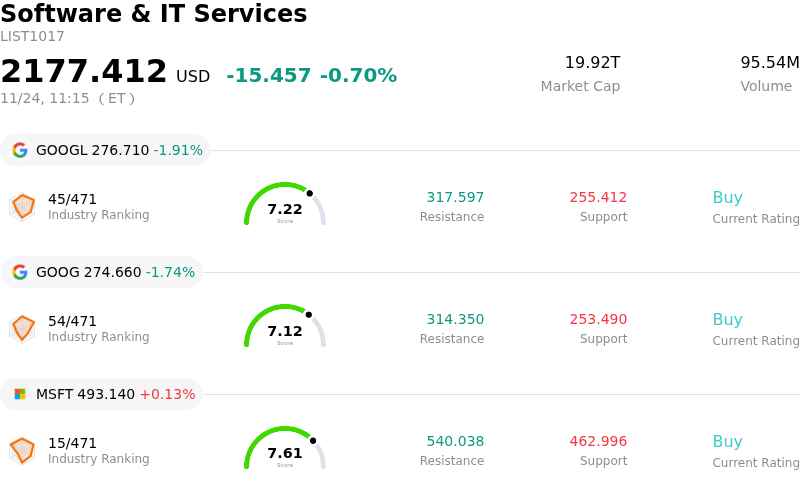
Oracle Corp (ORCL) moved down by 4.50%. The Software & IT Services sector is down by 0.70%. The company underperformed the industry. Top 3 stocks by turnover in the sector: Alphabet Inc Class A (GOOGL) down 1.91%; Alphabet Inc Class C (GOOG) down 1.74%; Microsoft Corp (MSFT) up 0.13%.
What is driving Oracle Corp (ORCL)’s stock price down today?
Oracle is experiencing noticeable downward pressure during today's session as institutional investors recalibrate exposure across enterprise software and cloud infrastructure providers. The broader market environment has seen an uptick in risk aversion, with capital rotating out of high-multiple technology equities amid persistent macroeconomic crosscurrents and scrutiny over enterprise IT capital allocation. In this context, software and cloud providers that have rallied on multi-year artificial intelligence narratives are facing valuation compression as market participants demand clearer visibility into near-term monetization and margin durability.
A primary catalyst weighing on sentiment is mounting concern surrounding the capital intensity of Oracle Cloud Infrastructure expansion. To satisfy surging commitments and backlog for artificial intelligence training and inference clusters, Oracle has had to commit substantial capital expenditures toward data center procurement, advanced silicon, and specialized power infrastructure. While this reflects strong commercial appetite, it also puts immediate pressure on free cash flow generation and raises questions among institutional analysts regarding near-term return on invested capital. Markets are increasingly sensitive to any potential mismatch between heavy upfront cash outlays and the subsequent timeline for high-margin revenue recognition.
Competitive dynamics across the hyperscale cloud landscape further compound these headwinds. Established market leaders continue to aggressively defend their enterprise footprint by bundling proprietary cloud workloads, software suites, and enterprise AI tools. As the race for enterprise cloud migrations intensifies, price competition and hardware delivery lead times pose execution risks. For Oracle, the operational challenge lies in sustaining robust revenue growth in its infrastructure-as-a-service division while managing the structural deceleration of legacy on-premises license support, which historically provided predictable, high-margin cash flows.
Additionally, portfolio managers are paying closer attention to balance sheet leverage and debt service costs in an environment where interest rates remain a key determinant of equity valuations. Given Oracle’s historical use of leverage to support share repurchases and strategic acquisitions, investors are less tolerant of capital spending overruns that could delay balance sheet deleveraging. Looking ahead, institutional sentiment will likely depend on management’s ability to demonstrate that its massive cloud backlog can be converted into profitable, cash-generative operations without diluting core operating margins.
Technical Analysis of Oracle Corp (ORCL)
Technically, Oracle Corp (ORCL) shows a MACD (12,26,9) value of -1.801, indicating a sell signal. The RSI at 40.747 suggests neutral condition and the Williams %R at 70.776 suggests sell condition. Please monitor closely.
Media Coverage of Oracle Corp (ORCL)
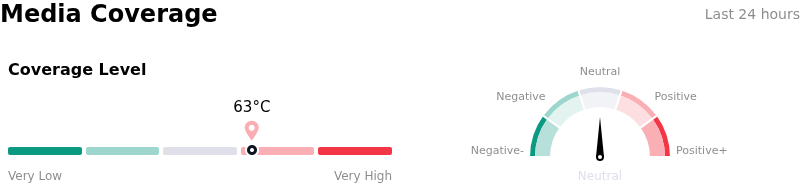
In terms of media coverage, Oracle Corp (ORCL) shows a coverage score of 63, indicating a high level of media attention. The overall market sentiment index is currently in neutral zone.
Fundamental Analysis of Oracle Corp (ORCL)
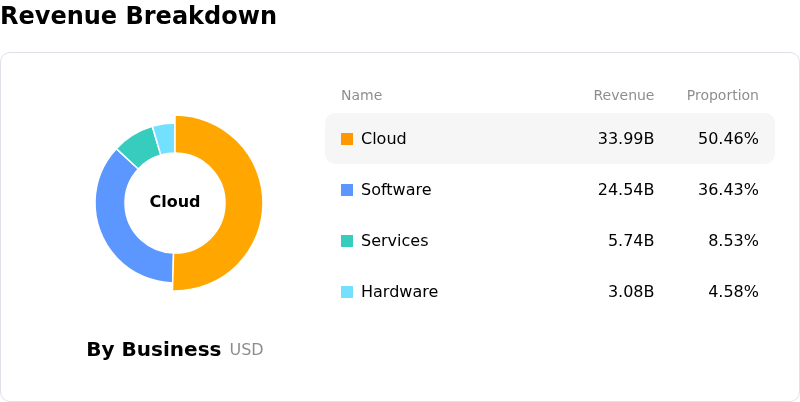
Oracle Corp (ORCL) is in the Software & IT Services industry. Its latest annual revenue is $67.36B, ranking 8 in the industry. The net profit is $16.98B, ranking 6 in the industry. Company Profile
Over the past month, multiple analysts have rated the company as Buy, with an average price target of $238.51, a high of $330.00, and a low of $110.00.
More details about Oracle Corp (ORCL)
Company Specific Risks:
- Elevated Debt Financing and Borrowing Costs: Following credit rating downgrades to BBB- (one notch above junk), recent debt issuances have carried coupon rates as high as 8.65%, drastically increasing debt service burdens and leaving the company exposed to elevated credit default swap spreads and tight bond market conditions.
- Severe Cash Burn and Capex-Driven Equity Dilution: Massive capital expenditures required for the AI data center buildout continue to result in substantial negative free cash flow, forcing management into an aggressive $20 billion financing split that relies heavily on dilutive at-the-market share offerings.
- Counterparty Concentration and Backlog Conversion Vulnerabilities: A major portion of Oracle's contracted backlog is tied to highly leveraged AI customers such as OpenAI, exposing cloud infrastructure revenue to client solvency risks, force majeure disruptions, and extended deployment delays.
- Margin Compression from Hardware and Infrastructure Inflation: Escalating costs for cutting-edge GPU architectures, alongside power procurement and construction bottlenecks, threaten to push fiscal 2027–2028 capital expenditures beyond guidance, depressing returns on invested capital across Oracle Cloud Infrastructure.
This article may include AI-generated content that is human-reviewed, which is for reference and general information purposes only and does not constitute investment advice.
Recommended Articles







Comments (0)
Click the $ button, enter the symbol, and select to link a stock, ETF, or other ticker.