


 Discount


T-Mobile US Inc Stock (TMUS) Moved Down by 3.04% on Nov 18: Drivers Behind the Movement


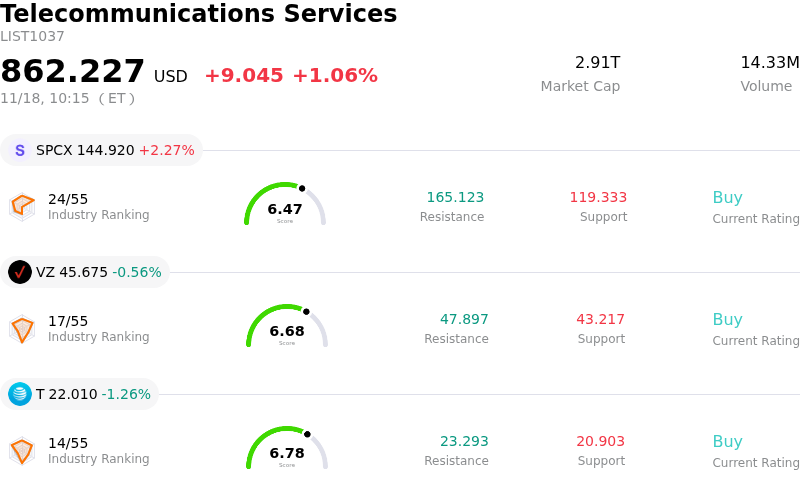
T-Mobile US Inc (TMUS) moved down by 3.04%. The Telecommunications Services sector is up by 1.06%. The company underperformed the industry. Top 3 stocks by turnover in the sector: SpaceX (SPCX) up 2.26%; Verizon Communications Inc (VZ) down 0.56%; AT&T Inc (T) down 1.26%.
What is driving T-Mobile US Inc (TMUS)’s stock price down today?
T-Mobile US experienced downward pressure as a confluence of heightened competitive dynamics in the domestic wireless sector and renewed scrutiny over long-term capital intensity weighed on institutional sentiment. While T-Mobile has maintained an industry-leading position in postpaid phone net additions, market participants are increasingly focused on signs of moderating customer growth across the broader telecommunications landscape. Elevated promotional activity from primary rivals AT&T and Verizon has stoked concerns that customer acquisition and retention costs could rise, potentially curbing margin expansion in upcoming quarters.
A central issue affecting investor appetite is the evolving growth profile of the fixed wireless access broadband business. As high-value, capacity-rich spectrum becomes more heavily utilized in mature urban and suburban corridors, questions have emerged regarding how long T-Mobile can sustain its rapid pace of broadband subscriber gains without committing more capital toward supplemental fiber infrastructure or additional spectrum assets. Investors are evaluating whether prospective joint ventures and fiber partnerships could dilute near-term free cash flow yields or require higher capital expenditures than previously modeled.
Broader macroeconomic conditions and capital allocation expectations have also played a role in the session's pullback. With interest rates remaining a critical consideration for capital-intensive industries, defensive equities with substantial debt profiles face continuous valuation discipline. Institutional funds have periodically trimmed exposure to top-performing wireless carriers to lock in gains or rotate into cyclical growth opportunities. Furthermore, any perception of a slower trajectory in share repurchase execution or rising leverage ratios tends to prompt tactical reallocations among risk-sensitive asset managers.
Looking ahead, T-Mobile remains fundamentally well-situated with superior mid-band spectrum depth and robust cash conversion efficiency relative to legacy peers. However, near-term stock performance will largely hinge on management demonstrating stable churn rates, sustained average revenue per account expansion, and disciplined capital management. Until clarity emerges regarding the competitive equilibrium and the capital requirements of its long-term broadband and network expansion strategies, TMUS shares may experience consolidation as the market digests these operational and macroeconomic headwinds.
Technical Analysis of T-Mobile US Inc (TMUS)
Technically, T-Mobile US Inc (TMUS) shows a MACD (12,26,9) value of 2.115, indicating a buy signal. The RSI at 49.478 suggests neutral condition and the Williams %R at 49.427 suggests neutral condition. Please monitor closely.
Fundamental Analysis of T-Mobile US Inc (TMUS)
T-Mobile US Inc (TMUS) is in the Telecommunications Services industry. Its latest annual revenue is $88.31B, ranking 4 in the industry. The net profit is $10.99B, ranking 4 in the industry. Company Profile
Over the past month, multiple analysts have rated the company as Buy, with an average price target of $224.84, a high of $310.00, and a low of $165.00.
More details about T-Mobile US Inc (TMUS)
Company Specific Risks:
- Competitive Overhang from Direct-to-Cell Satellite Disruption: Intraday volatility has been amplified as regulatory scrutiny over SpaceX's proposed $8 billion spectrum acquisition intensifies at the FCC, compounding investor concerns that expanding satellite-to-cellular capabilities and alternative carrier tie-ups will bypass traditional terrestrial 5G infrastructure and erode premium wireless pricing power.
- Postpaid Account Deceleration and Promotional Margin Compression: Fresh institutional commentary, highlighted by Citigroup's cautious Neutral stance, emphasizes persistent operational friction as elevated customer acquisition costs, aggressive device subsidies, and upticks in subscriber churn fail to convert top-line growth into sustainable operating margin expansion.
- Elevated Debt Burden Amid Upcoming Spectrum Outlays: Carrying over $77 billion in long-term debt, T-Mobile faces balance-sheet scrutiny as capital demands mount; management guidance signaling that substantial capital reserves will be diverted into mandatory 2027–2028 spectrum auctions raises immediate concerns that ongoing debt-service costs will crowd out future share buyback capacity.
- Executive Transition and Governance Execution Risks: Recent SEC filings detailing formal board departures and the phased handover from long-standing CFO Peter Osvaldik to CFO Designate Jessica Uhl introduce near-term management uncertainty, elevating operational execution risk while the carrier navigates decelerating postpaid growth and heightened wireless price wars.
This article may include AI-generated content that is human-reviewed, which is for reference and general information purposes only and does not constitute investment advice.
Recommended Articles






Comments (0)
Click the $ button, enter the symbol, and select to link a stock, ETF, or other ticker.