


Intuit Inc Stock (INTU) Moved Down by 5.35% on Nov 17: What Signal Does It Send?


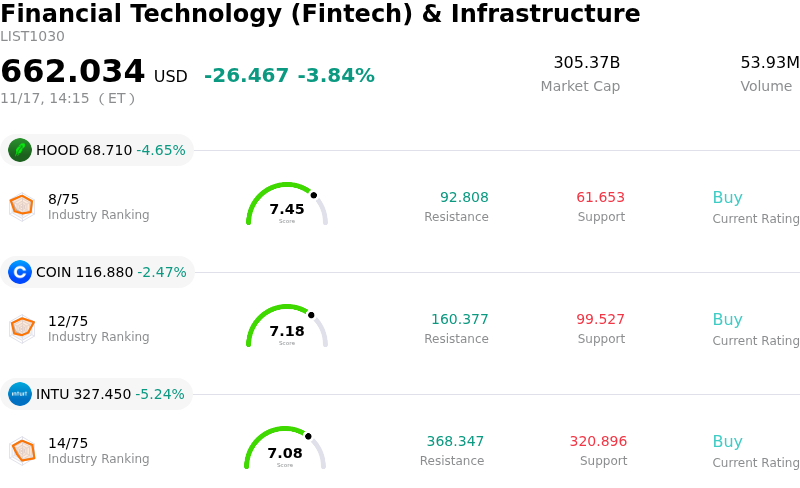
Intuit Inc (INTU) moved down by 5.35%. The Financial Technology (Fintech) & Infrastructure sector is down by 3.84%. The company underperformed the industry. Top 3 stocks by turnover in the sector: Robinhood Markets Inc (HOOD) down 4.65%; Coinbase Global Inc (COIN) down 2.47%; Intuit Inc (INTU) down 5.24%.
What is driving Intuit Inc (INTU)’s stock price down today?
Intuit encountered pronounced selling pressure as institutional investors adjusted their exposure ahead of the company's upcoming earnings release, reflecting broader de-risking across premium-valuation enterprise software and financial technology names. Market sentiment in the application software space has turned increasingly defensive, with institutional desks pulling back from richly valued platforms amid fluctuating bond yields and heightened scrutiny over cyclical end-market demand.
A central contributor to the downward movement is elevated investor anxiety regarding small-to-medium business health and consumer credit trends. Intuit's Small Business and Self-Employed segment, centered on QuickBooks and associated payroll and payment services, faces macro-level headwinds as higher borrowing costs and persistent operating expense pressures weigh on small enterprise formation and software spending. Concurrently, the Credit Karma division remains structurally exposed to consumer credit stress, where cautious underwriting standards among institutional lending partners continue to dampen personal loan and credit card placement activity.
Competitive and regulatory narratives have also exerted an overhang on market sentiment. The long-term trajectory of federal and state-sponsored digital tax filing options continues to introduce recurring headline friction for the TurboTax franchise, leaving some market participants cautious regarding future unit growth and pricing flexibility. Furthermore, rapid advancements in enterprise artificial intelligence tools have intensified the broader competitive discourse regarding whether specialized tax and bookkeeping platforms can sustain historical software moats or will face incremental pricing compression from automated agentic workflows.
From an equity valuation perspective, Intuit trades at a substantial premium to the broader market and vertical software peers, making its shares particularly susceptible to multiple compression when institutional capital rotates into more defensive or deeply discounted cyclical assets. Without an immediate corporate catalyst to alleviate near-term growth concerns, institutional portfolio adjustments and algorithmic momentum selling exacerbated the intraday decline. Near-term price discovery is expected to remain volatile until management delivers clarity regarding full-year margin expansion, monetization metrics for its generative AI integrations, and the operational durability of its core accounting ecosystem.
Technical Analysis of Intuit Inc (INTU)
Technically, Intuit Inc (INTU) shows a MACD (12,26,9) value of -4.629, indicating a neutral signal. The RSI at 46.345 suggests neutral condition and the Williams %R at 82.232 suggests oversold condition. Please monitor closely.
Fundamental Analysis of Intuit Inc (INTU)
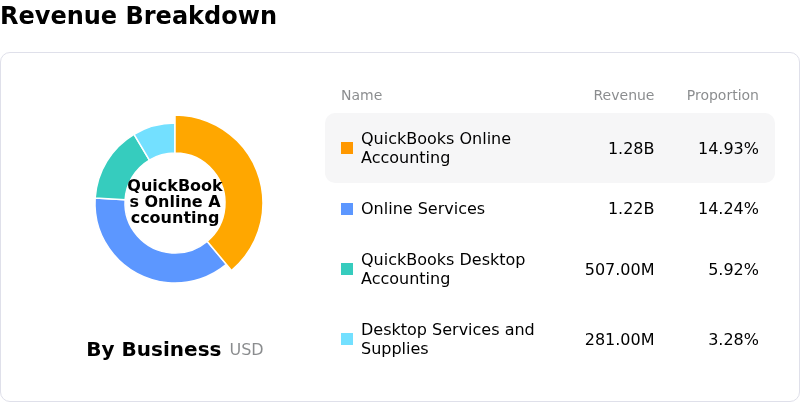
Intuit Inc (INTU) is in the Financial Technology (Fintech) & Infrastructure industry. Its latest annual revenue is $21.45B, ranking 2 in the industry. The net profit is $4.57B, ranking 1 in the industry. Company Profile
Over the past month, multiple analysts have rated the company as Buy, with an average price target of $410.55, a high of $750.00, and a low of $290.00.
More details about Intuit Inc (INTU)
Company Specific Risks:
- Pre-Earnings Positioning and Guidance Vulnerability: Institutional investors are aggressively reducing exposure ahead of the Q1 FY2027 earnings release on November 19, driven by elevated downside sensitivity since consensus estimates sit near the top of management's decelerated 9% to 10% revenue growth forecast, leaving zero operational margin for error outside the core tax season.
- Generative AI Disintermediation in Flagship Offerings: Severe sector-wide revaluations are penalizing Intuit over structural fears that automated AI agents and ultralow-cost alternatives will disintermediate TurboTax's consumer tax-filing base and pressure QuickBooks' seat-based business model, threatening legacy software pricing power.
- Customer Growth Stagnation and ARPU Dilution: Underlying online paying customer growth has stalled at just 3% as customers push back against recent price increases, compelling management to deploy free and lower-tier offerings—including Credit Karma Tax and QuickBooks Lite—that risk near-term average revenue per user and margin dilution.
- Analyst Sentiment Deterioration and Earnings Revisions: Wall Street consensus has turned increasingly cautious, marked by extensive downward earnings revisions and concerns surrounding reduced long-term Global Business Solutions growth frameworks alongside elevated stock-based compensation overhead.
This article may include AI-generated content that is human-reviewed, which is for reference and general information purposes only and does not constitute investment advice.
Recommended Articles








Comments (0)
Click the $ button, enter the symbol, and select to link a stock, ETF, or other ticker.