


Alibaba Group Holding Ltd Stock (BABA) Moved Down by 3.10% on Nov 17: Facts Behind the Movement


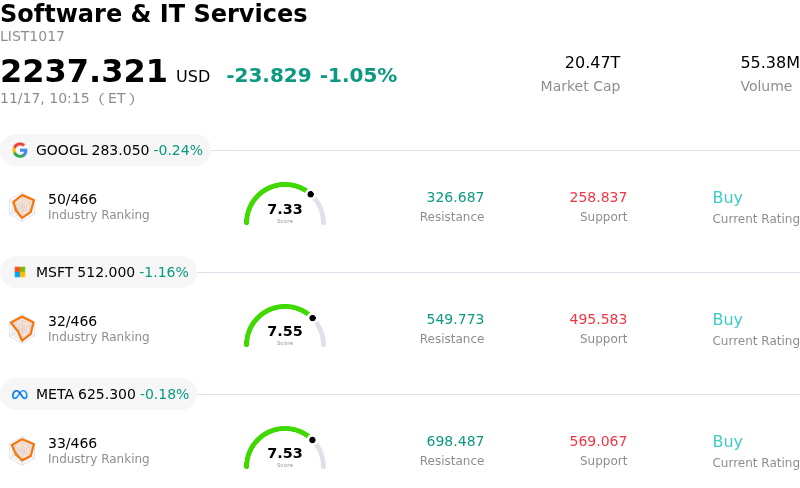
Alibaba Group Holding Ltd (BABA) moved down by 3.10%. The Software & IT Services sector is down by 1.05%. The company underperformed the industry. Top 3 stocks by turnover in the sector: Alphabet Inc Class A (GOOGL) down 0.25%; Microsoft Corp (MSFT) down 1.28%; Meta Platforms Inc (META) down 0.29%.
What is driving Alibaba Group Holding Ltd (BABA)’s stock price down today?
Alibaba Group Holding experienced notable downward pressure during today's trading session, driven primarily by a confluence of renewed macroeconomic concerns surrounding Chinese consumer spending, heightened competitive friction in domestic retail, and risk-off sentiment across Chinese technology depositary receipts. Institutional investors appear to be recalibrating their near-term exposure as broader market indicators suggest that retail consumption recovery remains uneven, dampening expectations for quick monetization rebounds across core e-commerce platforms.
A key factor weighing on sentiment is the intensifying battle for market share within the domestic retail ecosystem. Alibaba's Taobao and Tmall Group continues to allocate substantial capital toward price competitiveness, merchant subsidies, and customer acquisition to defend its footprint against discount platforms and short-video commerce channels. While these strategic reinvestments are essential to safeguard market dominance and stabilize gross merchandise volume, they inevitably exert downward pressure on adjusted earnings margins. Analysts and fund managers remain cautious about the timeline required for these margin-dilutive investments to convert into sustainable operating leverage.
Simultaneously, the Cloud Intelligence Group faces a nuanced operational backdrop. Although enterprise demand for artificial intelligence infrastructure and cloud migration provides long-term structural tailwinds, substantial upfront capital expenditures are required to sustain this technological expansion. Compounding this challenge are persistent international trade restrictions on advanced semiconductor imports, which inject uncertainty into the long-term cost structure and scalability of advanced high-performance computing clusters.
Broader geopolitical and currency factors also played a pivotal role in the session's weakness. Fluctuations in the foreign exchange market and ongoing geopolitical frictions between the United States and China have prompted international asset managers to trim tactical allocations to Chinese equities. As institutional portfolios execute defensive rebalancing, the broader ADR complex has faced persistent selling pressure, leading to the pullback seen across the shares today. Investors are likely to remain cautious until clearer catalysts emerge regarding domestic policy stimulus efficacy and sustained margin stabilization.
Technical Analysis of Alibaba Group Holding Ltd (BABA)
Technically, Alibaba Group Holding Ltd (BABA) shows a MACD (12,26,9) value of -2.660, indicating a sell signal. The RSI at 27.190 suggests sell condition and the Williams %R at 99.490 suggests oversold condition. Please monitor closely.
Fundamental Analysis of Alibaba Group Holding Ltd (BABA)
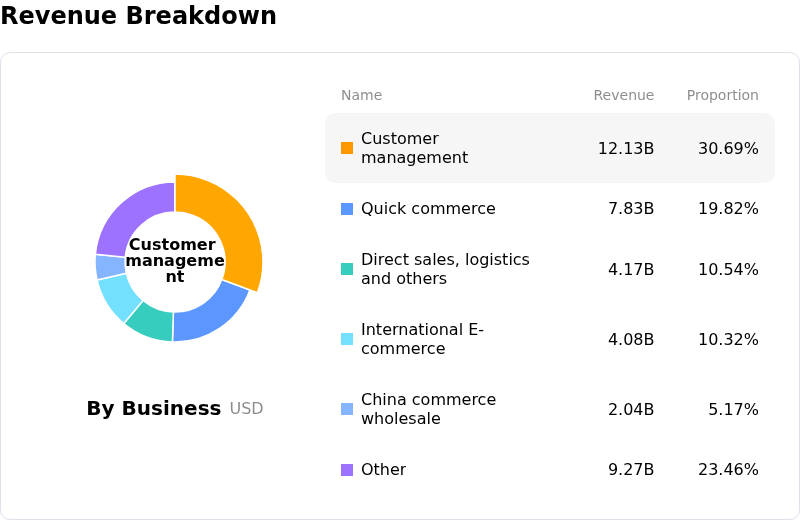
Alibaba Group Holding Ltd (BABA) is in the Software & IT Services industry. Its latest annual revenue is $144.14B, ranking 5 in the industry. The net profit is $14.91B, ranking 8 in the industry. Company Profile
Over the past month, multiple analysts have rated the company as Buy, with an average price target of $184.14, a high of $220.10, and a low of $95.00.
More details about Alibaba Group Holding Ltd (BABA)
Company Specific Risks:
- U.S. Export Controls on Offshore AI Computing: Scrutiny and impending U.S. Commerce Department restrictions closing offshore data center access to advanced Nvidia accelerators directly threaten Alibaba Cloud's computing capacity, with reports identifying Alibaba as the largest client renting foreign hardware through Megaspeed International.
- Core E-Commerce Margin Compression: Heightened merchant subsidies and aggressive price-slashing across Taobao and Tmall during recent promotional periods continue to erode retail operating margins and monetization take-rates amid intensifying platform competition.
- Escalating AI Capital Expenditures Pressuring Free Cash Flow: Aggressive multi-quarter capital expenditures dedicated to generative AI infrastructure and model scaling have depressed corporate operating margins without delivering commensurate near-term revenue acceleration, heightening earnings execution risk.
- Domestic Chip Transition Lag and Listing Hurdles: Proprietary silicon from semiconductor subsidiary T-Head still trails foreign alternatives, leaving operations vulnerable while next-generation Zhenwu chips remain years away from mass volume and T-Head's planned Hong Kong IPO faces unresolved regulatory clearances.
This article may include AI-generated content that is human-reviewed, which is for reference and general information purposes only and does not constitute investment advice.
Recommended Articles








Comments (0)
Click the $ button, enter the symbol, and select to link a stock, ETF, or other ticker.