


SAP SE Stock (SAP) Opened Down by 3.87% on Nov 17: Drivers Behind the Movement


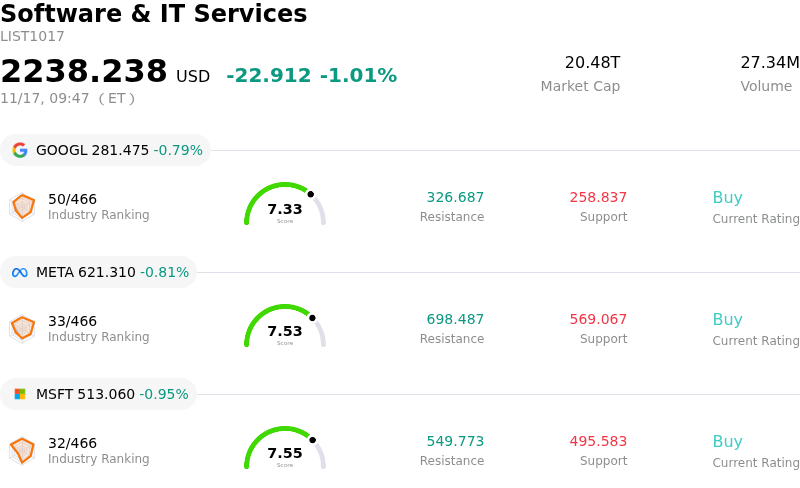
SAP SE (SAP) opened down by 3.87%. The Software & IT Services sector is down by 1.01%. The company underperformed the industry. Top 3 stocks by turnover in the sector: Alphabet Inc Class A (GOOGL) down 0.86%; Meta Platforms Inc (META) down 0.89%; Microsoft Corp (MSFT) down 0.95%.
What is driving SAP SE (SAP)’s stock price down today?
Shares of SAP came under noticeable selling pressure during Tuesday trading, weighed down by a confluence of sector-wide tech multiple compression, heightened scrutiny over corporate enterprise software budgets, and institutional profit-taking following its recent multi-quarter expansion. As market sentiment tilted defensive across large-cap technology, software providers with elevated valuation multiples faced widespread de-risking from institutional portfolios.
A key fundamental catalyst dampening investor appetite is persistent anxiety surrounding the velocity of enterprise cloud transformations. While SAP has demonstrated sustained momentum in migrating its installed base to S/4HANA Cloud and expanding its Current Cloud Backlog, enterprise technology buyers continue to navigate macroeconomic uncertainty. Reports across the broader software sector of elongated sales cycles, delayed discretionary IT expenditures, and intensified procurement scrutiny have renewed market skepticism regarding near-term cloud contract execution and upfront software license resilience.
Compounding these sector-level headwinds are foreign exchange and valuation dynamics. Because SAP trades at a valuation premium reflecting its high recurring revenue transition and operational restructuring efficiencies, any moderation in broader software risk appetite disproportionately impacts the stock. Furthermore, currency fluctuations between the euro and the U.S. dollar have added friction to American Depositary Receipt performance, prompting global macro and quant-driven funds to trim exposure across international enterprise tech holdings.
From an institutional standpoint, the pullback reflects tactical risk mitigation rather than an immediate deterioration in structural competitiveness. Investors will closely watch upcoming enterprise deal flow data, retention rates, and operating leverage metrics to determine whether the current softness represents temporary budget timing friction or a more pronounced plateau in corporate digital transformation spending.
Technical Analysis of SAP SE (SAP)
Technically, SAP SE (SAP) shows a MACD (12,26,9) value of -3.582, indicating a neutral signal. The RSI at 43.006 suggests neutral condition and the Williams %R at 100.000 suggests oversold condition. Please monitor closely.
Fundamental Analysis of SAP SE (SAP)
SAP SE (SAP) is in the Software & IT Services industry. Its latest annual revenue is $41.49B, ranking 15 in the industry. The net profit is $8.07B, ranking 14 in the industry. Company Profile
Over the past month, multiple analysts have rated the company as Buy, with an average price target of $278.90, a high of $367.98, and a low of $210.00.
More details about SAP SE (SAP)
Company Specific Risks:
- Elevated Valuation Multiple Vulnerability: Trading near 30x forward earnings with a PEG ratio exceeding 2.8, SAP faces heightened sensitivity to intraday multiple compression, leaving no margin for execution errors amid broad-based institutional rotation out of premium-valued enterprise application software.
- Executive Caution Over Cloud Backlog Moderation: Management commentary, including remarks from CFO Dominik Asam, highlighted that recent cloud acceleration was partly driven by one-off catch-up effects, heightening market anxiety regarding potential deceleration and macroeconomic headwinds affecting Q4 bookings.
- Enterprise AI ROI Scrutiny and Budget Competition: Recent institutional IT buyer surveys indicate increasing corporate pushback regarding demonstrable return on investment for generative AI additions, raising concerns that high rollout costs will stall customer adoption of monetized Joule AI agents in favor of internal IT architectures.
- Legacy Revenue Erosion and Complex Migration Friction: Accelerating erosion in high-margin legacy software licenses and support revenue creates persistent margin drag, which is exacerbated by client friction and protracted multi-year implementation cycles required for full S/4HANA cloud migration.
This article may include AI-generated content that is human-reviewed, which is for reference and general information purposes only and does not constitute investment advice.
Recommended Articles








Comments (0)
Click the $ button, enter the symbol, and select to link a stock, ETF, or other ticker.