


JPMorgan Chase & Co Stock (JPM) Moved Up by 3.72% on Nov 4: What Signal Does It Send?


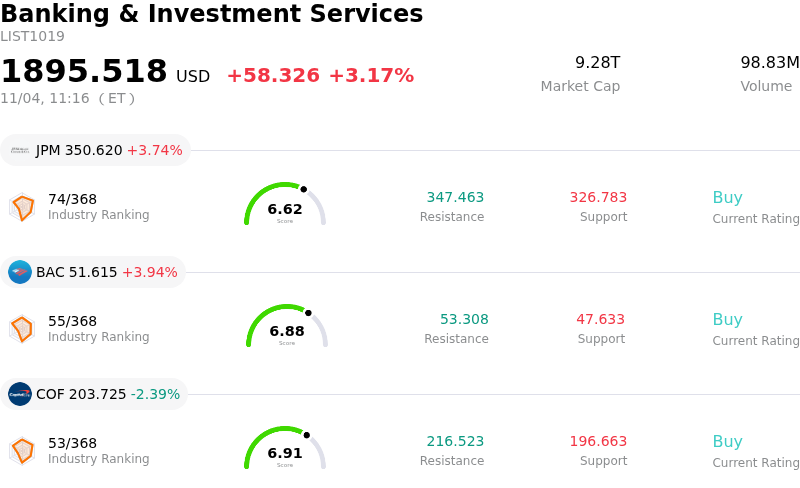
JPMorgan Chase & Co (JPM) moved up by 3.72%. The Banking & Investment Services sector is up by 3.17%. The company outperformed the industry. Top 3 stocks by turnover in the sector: JPMorgan Chase & Co (JPM) up 3.67%; Bank of America Corp (BAC) up 3.94%; Capital One Financial Corp (COF) down 2.39%.
What is driving JPMorgan Chase & Co (JPM)’s stock price up today?
The upward movement in JPMorgan Chase shares was primarily driven by a broader capital rotation across U.S. equities, as market participants reallocated funds out of high-valuation growth sectors into quality financial institution names. Amid ongoing macroeconomic adjustments, persistent inflation concerns, and shifting Federal Reserve rate expectations, money-center banks with substantial deposit bases have seen renewed investor interest. JPMorgan Chase, as the leading U.S. bank by assets, stood out as a primary beneficiary of this defensive sector rotation and improving market breadth, which triggered notable intraday buying activity.
Underlying corporate fundamentals continue to provide solid support for the stock. Management recently raised its full-year net interest income guidance, reflecting sustained strength in net interest margins and robust client activity across core operational segments, including commercial banking and asset management. Additionally, the firm continues to enhance its long-term competitive moat through technological innovations in its payments franchise, such as automated receivables matching and enterprise blockchain applications. These operational efficiency initiatives help offset rising non-interest expenses and support medium-term revenue visibility.
Institutional accumulation and portfolio adjustments have further sustained the stock's positive momentum. Large institutional asset managers and wealth management firms have maintained or expanded allocations to top-tier banking assets, favoring companies with fortress balance sheets and elevated returns on tangible common equity. Although the bank trades at a valuation premium relative to sector peers, market participants continue to view its disciplined capital allocation, strong credit reserve profile, and market-leading positions across investment banking and wealth management as justification for the premium. Consequently, institutional inflows and favorable sector trends provided a strong tailwind for the stock's performance.
Technical Analysis of JPMorgan Chase & Co (JPM)
Technically, JPMorgan Chase & Co (JPM) shows a MACD (12,26,9) value of 3.359, indicating a neutral signal. The RSI at 62.586 suggests neutral condition and the Williams %R at 1.317 suggests overbought condition. Please monitor closely.
Media Coverage of JPMorgan Chase & Co (JPM)
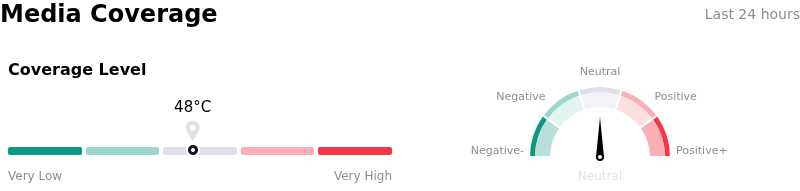
In terms of media coverage, JPMorgan Chase & Co (JPM) shows a coverage score of 48, indicating a moderate level of media attention. The overall market sentiment index is currently in neutral zone.
Fundamental Analysis of JPMorgan Chase & Co (JPM)
JPMorgan Chase & Co (JPM) is in the Banking & Investment Services industry. Its latest annual revenue is $181.82B, ranking 1 in the industry. The net profit is $55.68B, ranking 1 in the industry. Company Profile
Over the past month, multiple analysts have rated the company as Buy, with an average price target of $371.98, a high of $425.00, and a low of $312.00.
More details about JPMorgan Chase & Co (JPM)
Company Specific Risks:
- Earnings & Trading Revenue Miss: JPMorgan reported a quarterly earnings miss (EPS of $5.75 versus $5.94 expected), dragged down by an 8% sequential drop in investment banking fees and a 4% year-over-year decline in fixed-income trading revenue.
- Escalating Operating Expense Guidance: Management raised full-year adjusted expense guidance to $108.6 billion, triggering analyst concerns that operating costs are growing faster than top-line revenues and compressing profit margins.
- Capital Ratio Easing and Wholesale Debt Reliance: The bank's Q3 Form 10-Q filing confirmed capital ratios eased year-over-year due to realized securities losses, ongoing credit reserve builds, and external non-depositor financing exceeding $1.2 trillion, raising wholesale borrowing expense risks.
- Trimmed Share Buybacks and Foreign Tax Headwinds: Downside pressure is compounded by management trimming share repurchases and navigating international policy headwinds, such as the UK bank tax surcharge expected to add over £100 million in local tax liabilities.
This article may include AI-generated content that is human-reviewed, which is for reference and general information purposes only and does not constitute investment advice.
Recommended Articles









Comments (0)
Click the $ button, enter the symbol, and select to link a stock, ETF, or other ticker.