


SpaceX Stock (SPCX) Moved Down by 3.59% on Nov 4: Key Drivers Unveiled


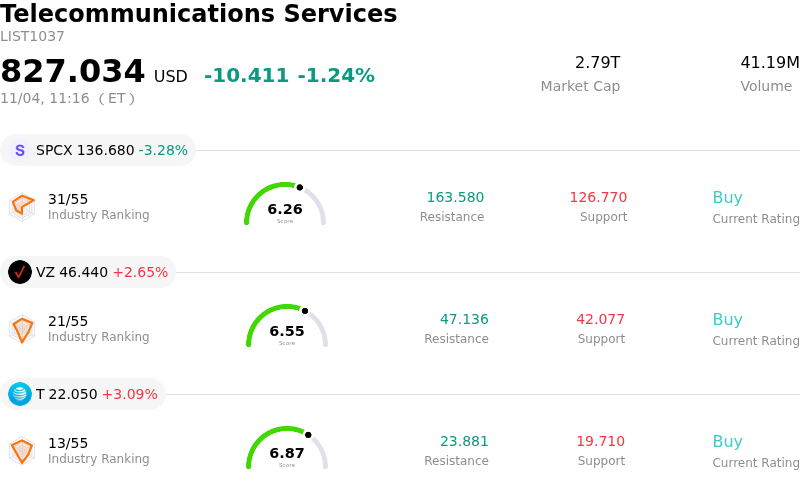
SpaceX (SPCX) moved down by 3.59%. The Telecommunications Services sector is down by 1.24%. The company underperformed the industry. Top 3 stocks by turnover in the sector: SpaceX (SPCX) down 3.57%; Verizon Communications Inc (VZ) up 2.65%; AT&T Inc (T) up 3.09%.
What is driving SpaceX (SPCX)’s stock price down today?
The recent downward pressure and heightened intraday volatility in SpaceX stem primarily from investor re-evaluation of the company's aggressive expansion into direct-to-cell mobile communications. While initial excitement around potential asset acquisitions and network-sharing agreements with established wireless carriers boosted shares in previous sessions, market sentiment cooled as reality set in regarding regulatory, operational, and competitive hurdles. Major legacy telecommunication operators have voiced strong opposition to potential network access terms, creating uncertainty around the timing, regulatory approval, and execution of a nationwide satellite-to-cellular network.
Compounding the downward momentum is growing scrutiny over the company's soaring capital intensity and heavy cash burn. Management's guidance for massive fourth-quarter capital expenditures, largely allocated toward expanding artificial intelligence compute capacity alongside core Starship and Starlink programs, has magnified free cash flow deficit concerns. Despite rapid top-line growth across its connectivity and high-performance computing divisions, the wide gap between operating cash flows and aggressive capital outlays highlights ongoing cash burn and raises fears of potential debt financing or secondary equity dilution.
Market dynamics are further amplified by structural trading mechanics and upcoming corporate milestones. The proliferation of single-stock leveraged exchange-traded funds tied to daily performance has generated substantial forced rebalancing flows, exacerbating intraday price swings. Additionally, approaching lockup expiration dates following the company's initial public offering are prompting institutional holders and early investors to de-risk and lock in gains. Combined with broader technology sector caution, these factors have tilted short-term supply-demand dynamics toward sell-side pressure.
Technical Analysis of SpaceX (SPCX)
Technically, SpaceX (SPCX) shows a MACD (12,26,9) value of -3.424, indicating a sell signal. The RSI at 40.300 suggests neutral condition and the Williams %R at 94.508 suggests oversold condition. Please monitor closely.
Fundamental Analysis of SpaceX (SPCX)
SpaceX (SPCX) is in the Telecommunications Services industry. Its latest annual revenue is $18.67B, ranking 10 in the industry. The net profit is $-4.94B, ranking 61 in the industry. Company Profile

Over the past month, multiple analysts have rated the company as Buy, with an average price target of $250.32, a high of $800.00, and a low of $118.00.
More details about SpaceX (SPCX)
Company Specific Risks:
- Severe Free Cash Flow Deficit and Capital Intensity: Despite strong revenue gains, SpaceX posted a negative free cash flow of nearly $9.96 billion over nine months, driven by $48.07 billion in capital expenditures that vastly outpaced operating cash flow of $13.10 billion, fueling institutional concerns over ongoing cash burn for Starship development and infrastructure.
- Post-Midterm Political and Regulatory Headwinds: Market volatility in SPCX shares increased following recent U.S. midterm election results, with analysts warning that shifts in congressional power introduce heightened regulatory scrutiny, potential hurdles for federal contract renewals, and legislative pushback against Musk-affiliated ventures.
- Elevated Valuation Multiples Exposing Execution Vulnerabilities: Wall Street analysis highlights that SpaceX trades at an extreme price-to-sales ratio near 60x and an EV/EBITDA multiple exceeding 400x, leaving the equity highly sensitive to sharp intraday re-ratings if Starlink subscriber growth or commercial launch schedules face minor missteps.
- Regulatory Review Risks for Spectrum Acquisition Talks: Unconfirmed reports of discussions with EchoStar to buy Boost Mobile assets or access its wireless network create execution and regulatory risk, as any final spectrum agreement faces federal oversight and potential pushback from incumbent carriers.
This article may include AI-generated content that is human-reviewed, which is for reference and general information purposes only and does not constitute investment advice.
Recommended Articles








Comments (0)
Click the $ button, enter the symbol, and select to link a stock, ETF, or other ticker.