


 Discount


New Zealand Dollar gains against US Dollar as NZ election outcome eases political uncertainty



- The New Zealand Dollar rises to near 0.5485 against the US Dollar as NZ political uncertainty eases.
- NZ PM Luxon’s three-part coalition falls short of one seat to gain majority.
- Investors shift their focus to key US economic releases scheduled next week.
The New Zealand Dollar (NZD) is up 0.3% at around 0.5485 against the US Dollar (USD) during the European trading session on Friday. The Kiwi pair gains as the antipodean gains due to increased hopes of the continuation New Zealand (NZ) fiscal policy, following the election outcome.
New Zealand Dollar Price Today
The table below shows the percentage change of New Zealand Dollar (NZD) against listed major currencies today. New Zealand Dollar was the strongest against the Japanese Yen.
| USD | EUR | GBP | JPY | CAD | AUD | NZD | CHF | |
|---|---|---|---|---|---|---|---|---|
| USD | 0.08% | -0.14% | 0.11% | -0.03% | -0.58% | -0.28% | 0.11% | |
| EUR | -0.08% | -0.23% | 0.03% | -0.11% | -0.66% | -0.36% | 0.02% | |
| GBP | 0.14% | 0.23% | 0.25% | 0.12% | -0.43% | -0.14% | 0.25% | |
| JPY | -0.11% | -0.03% | -0.25% | -0.14% | -0.69% | -0.39% | -0.01% | |
| CAD | 0.03% | 0.11% | -0.12% | 0.14% | -0.55% | -0.25% | 0.13% | |
| AUD | 0.58% | 0.66% | 0.43% | 0.69% | 0.55% | 0.31% | 0.69% | |
| NZD | 0.28% | 0.36% | 0.14% | 0.39% | 0.25% | -0.31% | 0.39% | |
| CHF | -0.11% | -0.02% | -0.25% | 0.00% | -0.13% | -0.69% | -0.39% |
The heat map shows percentage changes of major currencies against each other. The base currency is picked from the left column, while the quote currency is picked from the top row. For example, if you pick the New Zealand Dollar from the left column and move along the horizontal line to the US Dollar, the percentage change displayed in the box will represent NZD (base)/USD (quote).
Earlier in the day, NZ’s Electoral Commission showed that Prime Minister (PM) Christopher Luxon’s three-party coalition—comprising the ACT New Zealand, National Party, and New Zealand First—secured 65 seats in the 130-seat parliament, failing to gain majority by mere one seat.
It is highly likely that Luxon’s three-part coalition would join hands with centrist Opportunity Party to form government, as centre-left coalition of Labour, the Green Party and Te Pati Maori would not be able to form a government, even with the support of Opportunity, Economic Times (ET) reported.
Opportunity leader Qiulae Wong has previously said she will negotiate first with the party that secures the largest number of seats in parliament, ET added.
Meanwhile, the US Dollar trades flat while entering into the weekend. Going forward, investors will pay close attention to key United States (US) economic releases next week, notably Nonfarm Payrolls (NFP) data for November, which will be released on December 4.
The US NFP data is expected to have a significant impact on Federal Reserve’s (Fed) interest rate expectations. Currently, the CME FedWatch tool shows traders are almost certain that the Fed will hike interest rates in the December policy meeting.
NZD/USD Technical Analysis
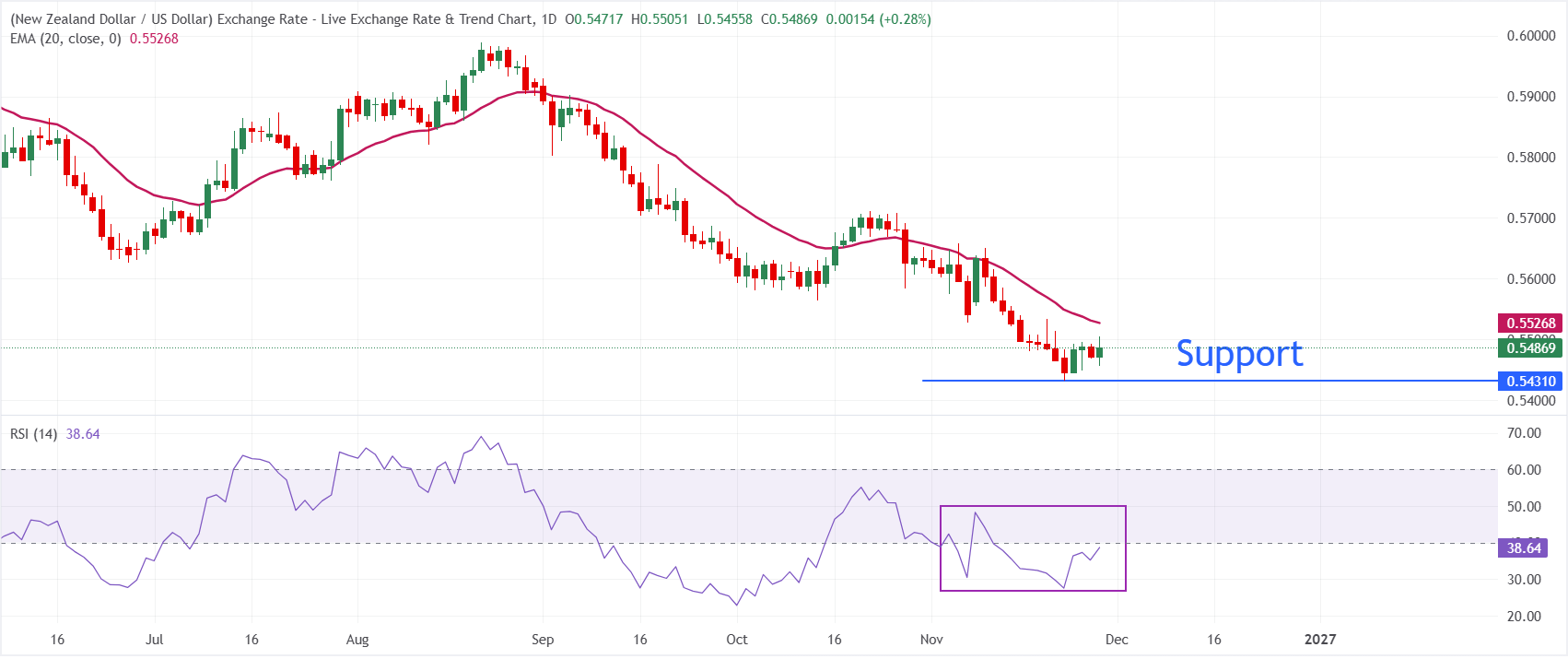
In the daily chart, NZD/USD trades at 0.5487, extending a bearish bias as spot remains below the 20-period exponential moving average (EMA) at 0.5527. The pair has failed to reclaim this dynamic barrier over recent sessions, keeping the broader tone heavy, while the Relative Strength Index (RSI) at 38.6 stays in a weak, slightly oversold region that hints at persistent downside pressure rather than an imminent bullish reversal.
On the topside, immediate resistance is located at the 20-day EMA around 0.5527, which caps recovery attempts and would need to be decisively cleared to ease the current bearish tone and open the way toward higher levels. On the downside, while no nearby price-based support is highlighted by the moving average structure, the subdued RSI suggests sellers could still press the pair to new lows before any meaningful corrective bounce develops.
(The technical analysis of this story was written with the help of an AI tool. Know more.)
New Zealand Dollar FAQs
The New Zealand Dollar (NZD), also known as the Kiwi, is a well-known traded currency among investors. Its value is broadly determined by the health of the New Zealand economy and the country’s central bank policy. Still, there are some unique particularities that also can make NZD move. The performance of the Chinese economy tends to move the Kiwi because China is New Zealand’s biggest trading partner. Bad news for the Chinese economy likely means less New Zealand exports to the country, hitting the economy and thus its currency. Another factor moving NZD is dairy prices as the dairy industry is New Zealand’s main export. High dairy prices boost export income, contributing positively to the economy and thus to the NZD.
The Reserve Bank of New Zealand (RBNZ) aims to achieve and maintain an inflation rate between 1% and 3% over the medium term, with a focus to keep it near the 2% mid-point. To this end, the bank sets an appropriate level of interest rates. When inflation is too high, the RBNZ will increase interest rates to cool the economy, but the move will also make bond yields higher, increasing investors’ appeal to invest in the country and thus boosting NZD. On the contrary, lower interest rates tend to weaken NZD. The so-called rate differential, or how rates in New Zealand are or are expected to be compared to the ones set by the US Federal Reserve, can also play a key role in moving the NZD/USD pair.
Macroeconomic data releases in New Zealand are key to assess the state of the economy and can impact the New Zealand Dollar’s (NZD) valuation. A strong economy, based on high economic growth, low unemployment and high confidence is good for NZD. High economic growth attracts foreign investment and may encourage the Reserve Bank of New Zealand to increase interest rates, if this economic strength comes together with elevated inflation. Conversely, if economic data is weak, NZD is likely to depreciate.
The New Zealand Dollar (NZD) tends to strengthen during risk-on periods, or when investors perceive that broader market risks are low and are optimistic about growth. This tends to lead to a more favorable outlook for commodities and so-called ‘commodity currencies’ such as the Kiwi. Conversely, NZD tends to weaken at times of market turbulence or economic uncertainty as investors tend to sell higher-risk assets and flee to the more-stable safe havens.
Recommended Articles







Comments (0)
Click the $ button, enter the symbol, and select to link a stock, ETF, or other ticker.