


 Discount


New Zealand Dollar struggles to extend recovery beyond 0.5490 against US Dollar



- New Zealand Dollar faces obstacles in capitalizing on early gains vs. the US Dollar.
- The US Dollar attracts slight bids on expectations that the Fed’s tightening cycle will stay for longer.
- The US core PCE inflation accelerated to 3.3% YoY in October.
The New Zealand Dollar (NZD) struggles to extend its two-day recovery move beyond 0.5490 against US Dollar (USD) in the Asian trade on Thursday. The Kiwi pair appears lacking strength as the US Dollar regains ground, following hot United States (US) Personal Consumption Expenditure (PCE) Price Index data for October that bolsters the case of a longer Federal Reserve’s (Fed) monetary tightening cycle.
As of writing, the US Dollar Index (DXY), which gauges the Greenback’s value against six major currencies, finds bids after revisiting Monday’s low near 103.50 and is marginally higher to near 103.77.
On Wednesday, the PCE inflation report showed that core figures grew at a faster-than-expected pace of 3.3% Year-on-Year (YoY) vs. 3.2% estimates and the prior reading of 3.1%.
According to the CME FedWatch tool, financial markets are increasingly confident that the Fed will hike interest rates in the December policy meeting.
Meanwhile, a quiet move is highly likely in the US Dollar during as day as US markets will remain closed due to Thanksgiving Day.
On the Kiwi front, traders expect the Reserve Bank of New Zealand (RBNZ) to deliver an interest rate hike in the December policy meeting. In the October gathering, the RBNZ unexpectedly left its Official Cash Rate (OCR) steady at 2.75%, while the central bank was expected to deliver a quarter-to-a-point rate hike.
NZD/USD Technical Analysis
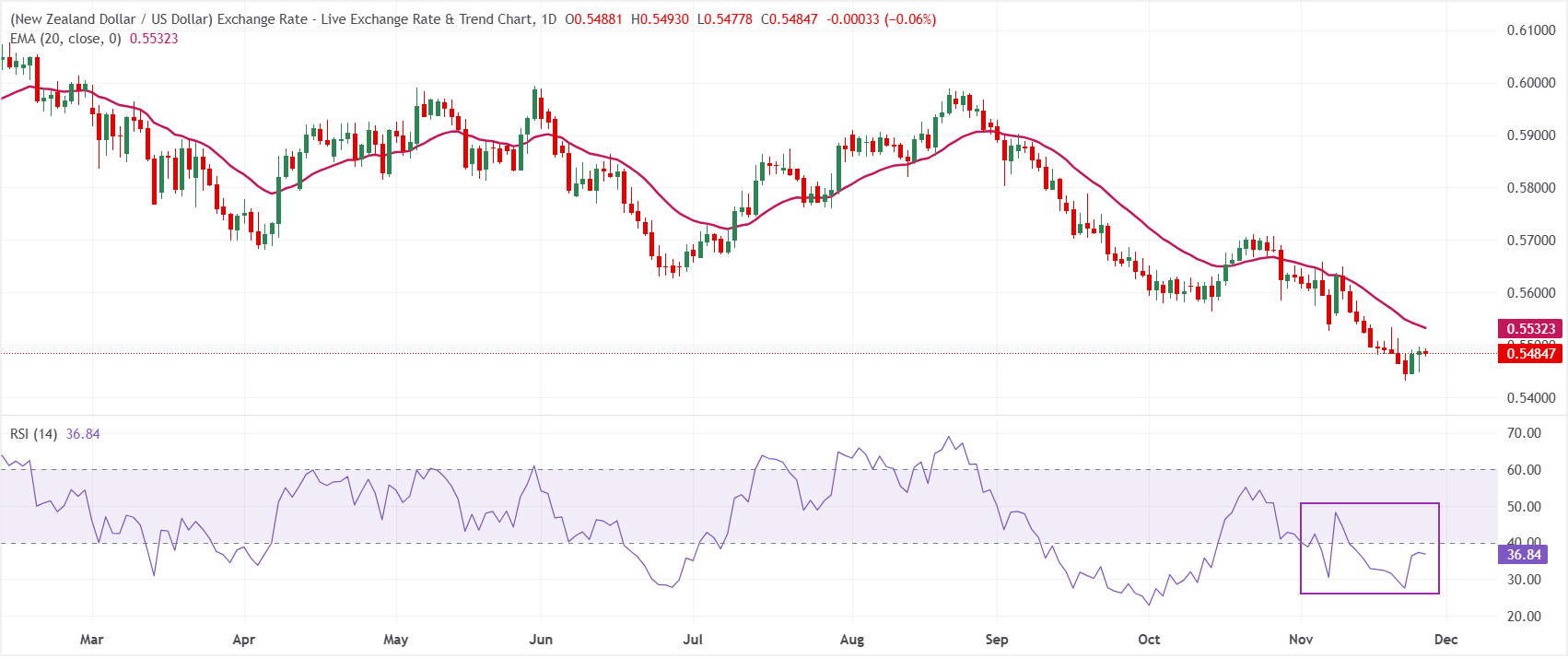
In the daily chart, NZD/USD trades at 0.5485, maintaining a bearish near-term tone as spot holds below the 20-period exponential moving average (EMA) at 0.5532. The pair remains pressured after its recent slide, with the EMA now acting as immediate overhead supply, while the Relative Strength Index (RSI) at 36.9 stays below the neutral 50 line, hinting that downside momentum remains in play but shy of oversold conditions.
On the topside, initial resistance is located at the 20-period EMA at 0.5532, and a sustained break above this barrier would be needed to ease the current bearish bias and open the door for a broader recovery. On the downside, the lack of nearby mapped technical supports from the provided dataset suggests that any fresh lows below 0.5485 would expose the pair to further weakness, with traders likely watching for new horizontal levels to emerge on subsequent price action.
(The technical analysis of this story was written with the help of an AI tool. Know more.)
Economic Indicator
Core Personal Consumption Expenditures - Price Index (YoY)
The Core Personal Consumption Expenditures (PCE), released by the US Bureau of Economic Analysis on a monthly basis, measures the changes in the prices of goods and services purchased by consumers in the United States (US). The PCE Price Index is also the Federal Reserve’s (Fed) preferred gauge of inflation. The YoY reading compares the prices of goods in the reference month to the same month a year earlier. The core reading excludes the so-called more volatile food and energy components to give a more accurate measurement of price pressures." Generally, a high reading is bullish for the US Dollar (USD), while a low reading is bearish.
Last release: Wed Nov 25, 2026 13:30
Frequency: Monthly
Actual: 3.3%
Consensus: 3.2%
Previous: 3.1%
Source: US Bureau of Economic Analysis
After publishing the GDP report, the US Bureau of Economic Analysis releases the Personal Consumption Expenditures (PCE) Price Index data alongside the monthly changes in Personal Spending and Personal Income. FOMC policymakers use the annual Core PCE Price Index, which excludes volatile food and energy prices, as their primary gauge of inflation. A stronger-than-expected reading could help the USD outperform its rivals as it would hint at a possible hawkish shift in the Fed’s forward guidance and vice versa.
Recommended Articles









Comments (0)
Click the $ button, enter the symbol, and select to link a stock, ETF, or other ticker.