


New Zealand Dollar gives back nearly half its election gain on US CPI



- NZD/USD slips back to 0.5600 after its post-election climb on Monday.
- Traders price US rates near 4.50%-4.75% by June, against the RBNZ's 2.75%.
- New Zealand's October card spending comes Wednesday, then its PMI Thursday.
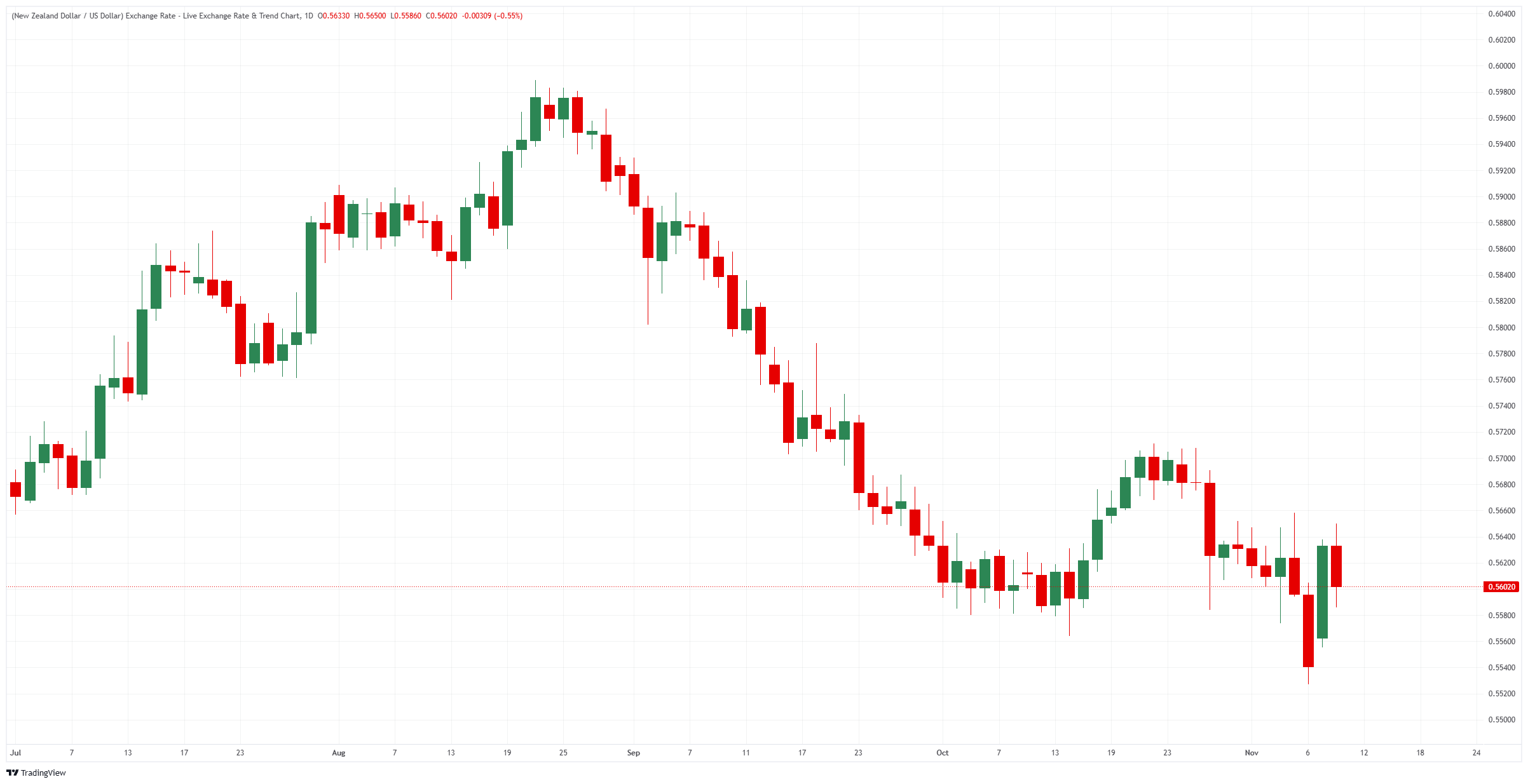
National's slim lead in New Zealand's election count helped the New Zealand Dollar rise on Monday, and nearly half that gain is gone after hot US consumer prices. It fell to just under 0.5600 before edging back to that level.
Kansas City Fed President Schmid said he can't find restriction from the Fed's rate outside housing, after October US consumer prices rose more than forecast. Traders price the Fed at 4.50%-4.75% by June, three quarter-point hikes from here, against 2.75% at the Reserve Bank of New Zealand (RBNZ). That would put the US 1.75-2.00 percentage points ahead of New Zealand unless the RBNZ moves as well.
National and its partners are projected at 67 of 131 seats, one more than a majority needs, with nearly 400K special votes to count by November 27. Labour had pledged to add a jobs goal for the RBNZ, and markets expect a National-led government to keep its focus on inflation alone. That's the outcome that helped the New Zealand Dollar on Monday.
On the calendar
Philadelphia Fed President Paulson, who votes on rates this year, speaks at 23:30 GMT on Tuesday. Core US producer prices, expected up 0.3% on the month after 0.7%, arrive on Friday at 13:30 GMT, and San Francisco Fed President Daly speaks at 17:00 GMT that day. They feed a December Fed hike that traders treat as a given.
New Zealand's October card spending is due at 21:45 GMT on Wednesday, after a 0.4% drop in September. The Business NZ Purchasing Managers Index (PMI) follows at 21:30 GMT on Thursday, after 56.5. Both feed the RBNZ's December 9 decision, the same day the Fed decides.
On the charts
The New Zealand Dollar has recovered about 40% of the drop from its October 22 high near 0.5700 to its November 6 low just above 0.5500. Both are well below its late-August high just under 0.6000, from which it has lost more than 6%.
NZD/USD daily chart
New Zealand Dollar FAQs
The New Zealand Dollar (NZD), also known as the Kiwi, is a well-known traded currency among investors. Its value is broadly determined by the health of the New Zealand economy and the country’s central bank policy. Still, there are some unique particularities that also can make NZD move. The performance of the Chinese economy tends to move the Kiwi because China is New Zealand’s biggest trading partner. Bad news for the Chinese economy likely means less New Zealand exports to the country, hitting the economy and thus its currency. Another factor moving NZD is dairy prices as the dairy industry is New Zealand’s main export. High dairy prices boost export income, contributing positively to the economy and thus to the NZD.
The Reserve Bank of New Zealand (RBNZ) aims to achieve and maintain an inflation rate between 1% and 3% over the medium term, with a focus to keep it near the 2% mid-point. To this end, the bank sets an appropriate level of interest rates. When inflation is too high, the RBNZ will increase interest rates to cool the economy, but the move will also make bond yields higher, increasing investors’ appeal to invest in the country and thus boosting NZD. On the contrary, lower interest rates tend to weaken NZD. The so-called rate differential, or how rates in New Zealand are or are expected to be compared to the ones set by the US Federal Reserve, can also play a key role in moving the NZD/USD pair.
Macroeconomic data releases in New Zealand are key to assess the state of the economy and can impact the New Zealand Dollar’s (NZD) valuation. A strong economy, based on high economic growth, low unemployment and high confidence is good for NZD. High economic growth attracts foreign investment and may encourage the Reserve Bank of New Zealand to increase interest rates, if this economic strength comes together with elevated inflation. Conversely, if economic data is weak, NZD is likely to depreciate.
The New Zealand Dollar (NZD) tends to strengthen during risk-on periods, or when investors perceive that broader market risks are low and are optimistic about growth. This tends to lead to a more favorable outlook for commodities and so-called ‘commodity currencies’ such as the Kiwi. Conversely, NZD tends to weaken at times of market turbulence or economic uncertainty as investors tend to sell higher-risk assets and flee to the more-stable safe havens.
Recommended Articles








Comments (0)
Click the $ button, enter the symbol, and select to link a stock, ETF, or other ticker.