


Euro seems vulnerable near yearly low, Fed-ECB policy is under spotlight


- The Euro trades vulnerably near its yearly low of 1.1113 against the US Dollar ahead of Fed’s policy decision.
- Higher oil prices and French fiscal risks continue to keep the Euro under pressure.
- Both the Fed and the ECB are expected to hold interest rates steady.
The Euro (EUR) trades close to its yearly low of 1.1113 against the US Dollar (USD) during the European trading session on Wednesday. The major currency pair is under pressure as heightened concerns in French bond markets and rising oil prices continue to weigh on the Euro.
Euro pressured as French spreads widen and confidence hits 2022 lows
Strategists at Scotiabank point out that domestic political strains are increasingly visible in French markets, with “French bonds … underperforming, nudging the spread over 10Y bunds back up to 161bps.” They add that sentiment has deteriorated sharply, as “French Consumer Confidence plunged to 80 in October, equaling the low seen in 2022, reflecting recent pollical tensions and social unrest.”
Meanwhile, oil prices have accelerated as Iran-backed Houthis’ drone attack on Saudi Arabia’s biggest oil facility has fanned fears of further energy supply risks.
On Tuesday, a military spokesperson from Iran-aligned Houthis said that they had hit Saudi Arabia’s biggest oil refinery with a missile, intensifying their strikes against the world’s second-largest crude producer. Saudi authorities did not immediately confirm the strike on the 550,000 barrel per day facility, Reuters report.
Going forward, major triggers for the Euro will be the European Central Bank’s monetary policy announcement on Thursday and the preliminary German Harmonized Index of Consumer Prices (HICP) data for October on Friday. The ECB is expected to hold interest rates steady.
On the US Dollar front, investors await the Federal Reserve’s (Fed) monetary policy announcement at 18:00 GMT.
Fed in focus as Danske Bank looks for December and March hikes
Analysts at Danske Bank highlight that, in the US, “the main event of the week is this evening's FOMC rate decision and the following press conference,” where they “expect the Fed to keep policy rates unchanged, in line with consensus, while markets price in a 10% probability of a hike.”
The bank notes that “most central FOMC members have signalled that they can wait until December before hiking again, although a few see more urgency,” and therefore they “expect 2-3 dissenting votes in favour of a hike.”
Overall, Danske Bank reiterates that it “still see[s] a need for further tightening” and that “all eyes are on Fed, which are expected to leave rates unchanged.” In their base case, Chair Powell is expected “to reiterate his firm commitment to bringing inflation back to target,” with the bank maintaining its call for “two more hikes, in December and March.”
EUR/USD Technical Analysis
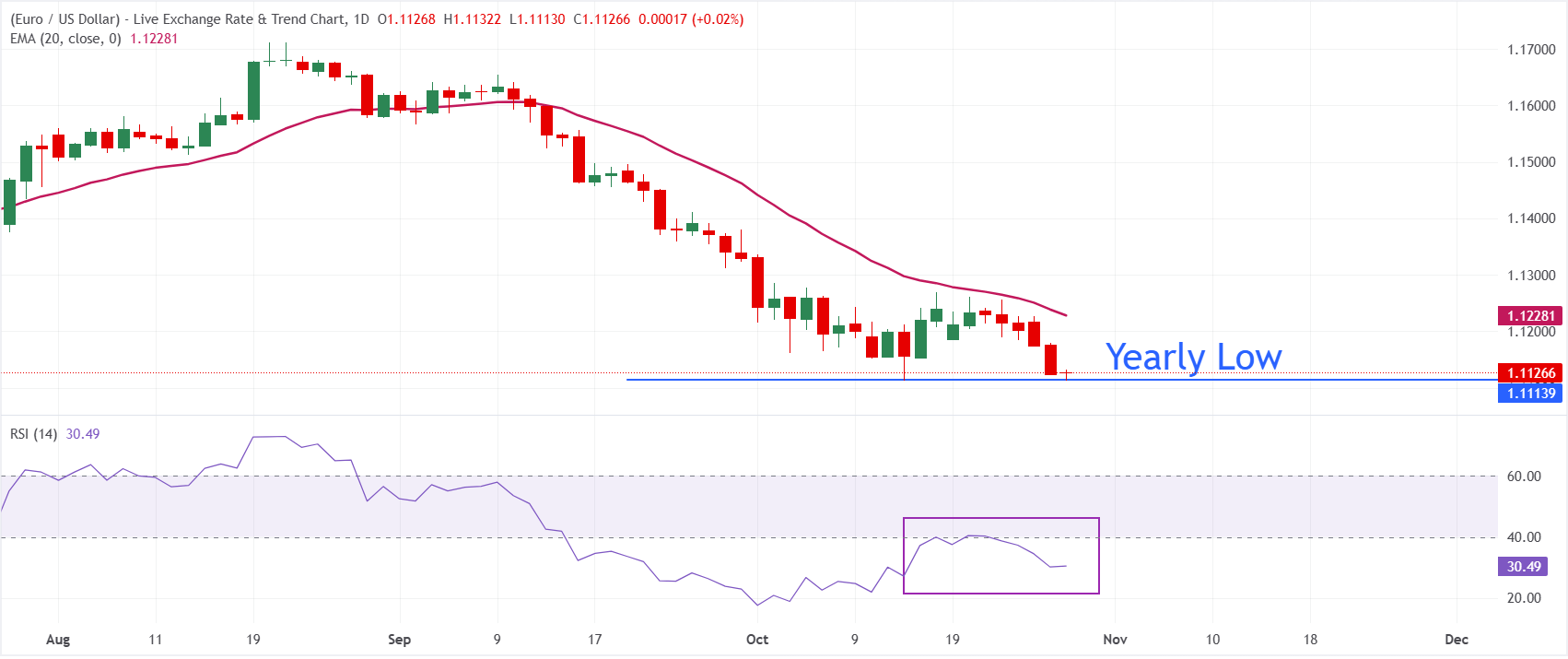
In the daily chart, EUR/USD trades at 1.1126, extending a bearish stance as spot holds below the 20-day exponential moving average (EMA) at 1.1228. The pair remains pressured while capped by this dynamic resistance, and the Relative Strength Index (RSI) near 30 hints that downside momentum is still dominant, though approaching oversold territory could slow the immediate selling pace rather than reverse the trend.
On the topside, initial resistance is located at the 20-day EMA around 1.1228, and a daily close above this level would be needed to ease the current bearish pressure and signal a more sustained corrective bounce. Until that barrier is reclaimed, rallies are likely to be viewed as corrective within the broader decline, with the lack of nearby structural supports on the chart leaving the pair vulnerable to fresh lows if sellers regain traction.
(The technical analysis of this story was written with the help of an AI tool. Know more.)
Economic Indicator
Fed Interest Rate Decision
The Federal Reserve (Fed) deliberates on monetary policy and makes a decision on interest rates at eight pre-scheduled meetings per year. It has two mandates: to keep inflation at 2%, and to maintain full employment. Its main tool for achieving this is by setting interest rates – both at which it lends to banks and banks lend to each other. If it decides to hike rates, the US Dollar (USD) tends to strengthen as it attracts more foreign capital inflows. If it cuts rates, it tends to weaken the USD as capital drains out to countries offering higher returns. If rates are left unchanged, attention turns to the tone of the Federal Open Market Committee (FOMC) statement, and whether it is hawkish (expectant of higher future interest rates), or dovish (expectant of lower future rates).
Next release: Wed Oct 28, 2026 18:00
Frequency: Irregular
Consensus: 4%
Previous: 4%
Source: Federal Reserve
Recommended Articles








Comments (0)
Click the $ button, enter the symbol, and select to link a stock, ETF, or other ticker.