


USD/CHF Price Forecast: Flag support rebound keeps bulls alive



- USD/CHF rebounds from flag support as buyers defend structure.
- RSI climbs above neutral, supporting near-term upside momentum.
- Break above 0.8135 targets flag top and 0.8200.
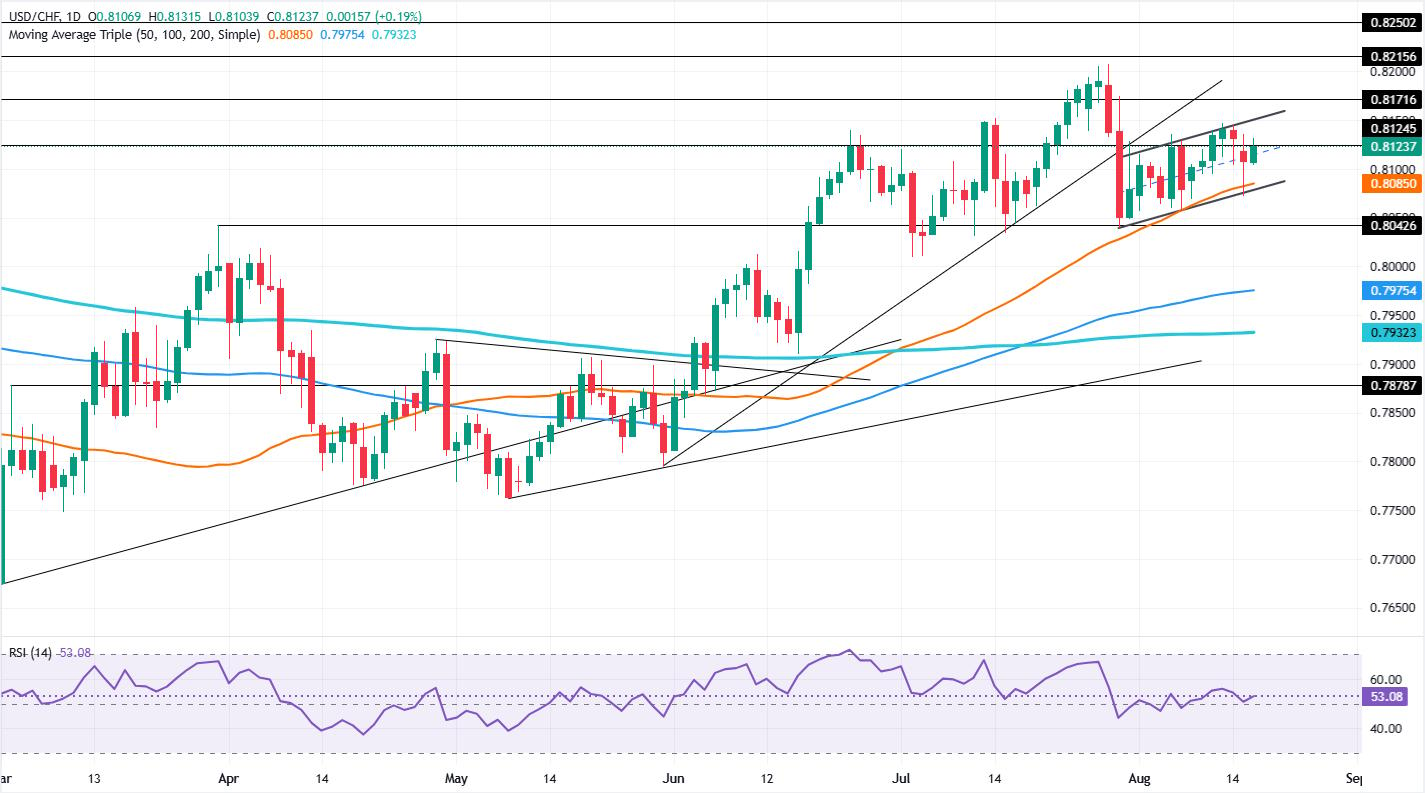
The USD/CHF recovers some ground after testing the 50-day Simple Moving Average (SMA) of 0.7866 along with the bottom trendline of the ‘bearish flag’, which so far contained price action amid the lack of conviction of buyers and sellers, regarding the trend’s direction. The pair trades at 0.7960, near the day's highs, up 0.82%.
USD/CHF Price Forecast: Technical Outlook
Per market structure, the USD/CHF is neutral to upward-biased, with momentum favouring buyers, as depicted by the Relative Strength Index (RSI), which is above its 50-neutral level and trending higher.
For a bullish continuation, the USD/CHF must surpass August’s 17 high of 0.8135. Once cleared, it opens the path to challenge the top trendline of the ‘bearish flag.” A breach of the latter will negate the ‘bearish’ chart pattern and pave the way towards 0.8200, followed by the yearly high of 0.8207.
On the downside, if USD/CHF fails to clear 0.8135 and finishes the session below 0.8100, this could exacerbate a move to the 50-day SMA at 0.8084. A move beneath clears the path to the July 30 swing low of 0.8049, ahead of 0.8000.
USD/CHF Price Chart – Daily
Swiss Franc FAQs
The Swiss Franc (CHF) is Switzerland’s official currency. It is among the top ten most traded currencies globally, reaching volumes that well exceed the size of the Swiss economy. Its value is determined by the broad market sentiment, the country’s economic health or action taken by the Swiss National Bank (SNB), among other factors. Between 2011 and 2015, the Swiss Franc was pegged to the Euro (EUR). The peg was abruptly removed, resulting in a more than 20% increase in the Franc’s value, causing a turmoil in markets. Even though the peg isn’t in force anymore, CHF fortunes tend to be highly correlated with the Euro ones due to the high dependency of the Swiss economy on the neighboring Eurozone.
The Swiss Franc (CHF) is considered a safe-haven asset, or a currency that investors tend to buy in times of market stress. This is due to the perceived status of Switzerland in the world: a stable economy, a strong export sector, big central bank reserves or a longstanding political stance towards neutrality in global conflicts make the country’s currency a good choice for investors fleeing from risks. Turbulent times are likely to strengthen CHF value against other currencies that are seen as more risky to invest in.
The Swiss National Bank (SNB) meets four times a year – once every quarter, less than other major central banks – to decide on monetary policy. The bank aims for an annual inflation rate of less than 2%. When inflation is above target or forecasted to be above target in the foreseeable future, the bank will attempt to tame price growth by raising its policy rate. Higher interest rates are generally positive for the Swiss Franc (CHF) as they lead to higher yields, making the country a more attractive place for investors. On the contrary, lower interest rates tend to weaken CHF.
Macroeconomic data releases in Switzerland are key to assessing the state of the economy and can impact the Swiss Franc’s (CHF) valuation. The Swiss economy is broadly stable, but any sudden change in economic growth, inflation, current account or the central bank’s currency reserves have the potential to trigger moves in CHF. Generally, high economic growth, low unemployment and high confidence are good for CHF. Conversely, if economic data points to weakening momentum, CHF is likely to depreciate.
As a small and open economy, Switzerland is heavily dependent on the health of the neighboring Eurozone economies. The broader European Union is Switzerland’s main economic partner and a key political ally, so macroeconomic and monetary policy stability in the Eurozone is essential for Switzerland and, thus, for the Swiss Franc (CHF). With such dependency, some models suggest that the correlation between the fortunes of the Euro (EUR) and the CHF is more than 90%, or close to perfect.
Recommended Articles








Comments (0)
Click the $ button, enter the symbol, and select to link a stock, ETF, or other ticker.