


Bitcoin Price Forecast: Nvidia earnings, Anthropic IPO put fragile BTC recovery to the test



- Bitcoin struggles to regain ground, trading below $65,000 after hitting a low near $62,000 last week.
- Investors turn their attention to Nvidia’s earnings and Anthropic’s IPO this week for fresh signals on AI-sector valuations and broader risk appetite.
- Elevated US Treasury yields, a stronger US Dollar and continued outflows from US-listed BTC spot ETFs weigh on Bitcoin, limiting recovery attempts.
Bitcoin (BTC) remains under pressure, trading below $65,000 on Tuesday after extending its decline to a low of $62,006 last week, levels not seen since mid-July. Market participants now turn their attention to Nvidia’s (NVDA) earnings and Anthropic’s upcoming Initial Public Offering (IPO) this week for fresh signals on AI-sector valuations and broader risk appetite.
Meanwhile, elevated US bond yields, a stronger US Dollar (USD) and persistent institutional outflows from spot Bitcoin Exchange Traded Funds (ETFs) continue to cap Crypto King’s recovery.
All eyes on Nvidia and Anthropic
Bitcoin price has dumped sharply, reaching a low of $62,006 last week amid multiple headwinds as explained in the previous report. The Crypto King is struggling below $65,000 as traders turn their attention to Nvidia’s earnings and Anthropic’s IPO this week for fresh signals on AI-sector valuations and broader risk appetite.
Nvidia’s ongoing leadership crisis is weighing on the broader industry ahead of its latest earnings results, to be released this Tuesday after the US market close.
Afterward, market participants will turn their attention to Anthropic’s anticipated market debut on Wednesday for further indications of investor demand for AI-related companies.
In an exclusive interview, Martin Lee, Market Insights Lead at DWF Labs, told FXStreet that the AI trade has been losing momentum since July as investors increasingly question the returns on enterprise token spending and capital expenditure (CapEx) by hyperscalers. While some optimism remains, investors have become more cautious about AI-sector valuations and spending.
Lee noted that whether capital flows into crypto will depend on whether investors shift their attention to alternative risk-on assets (after unwinding from AI) or move into entirely different asset classes.
He added that “how the markets shift when Anthropic IPOs will be a good indicator” of where investor appetite is heading.
On Bitcoin, Lee noted, “BTC’s immediate break below its 200-week moving average showed clear weakness. Moves this aggressive usually take time to digest, which fits the pattern from past midterm cycles: the first three to six months after a midterm have historically been weak for BTC. We expect volatility to stay high and price action to stay choppy until the market absorbs this move.”
Meanwhile, Simon-Peter Massabni, Head of Business Development at XS.com, warned that Nvidia’s earnings and Anthropic’s anticipated IPO could affect Bitcoin through liquidity conditions and shifts in investor appetite.
He explained that large public offerings could temporarily drain liquidity from financial markets, leaving Bitcoin vulnerable to sharper price swings if selling pressure intensifies. Massabni noted that this could further accelerate outflows from spot Bitcoin Exchange Traded Funds (ETFs), which have already recorded two consecutive weeks of outflows exceeding $2 billion each.
Regarding Nvidia’s earnings, Massabni highlighted two potential scenarios. If the results meet elevated market expectations, capital could remain concentrated in technology stocks rather than flow into alternative assets such as Bitcoin and Gold. Conversely, disappointing results could trigger broader equity-market selling, forcing investors to liquidate positions across other assets to meet margin calls and cover losses.
However, he added that “if the momentum surrounding artificial intelligence stocks cools down gradually without a deep collapse in the wider market,” capital could eventually return to Bitcoin as investors take advantage of lower price levels.
Elevated US bond yields and stronger US Dollar weigh on BTC
Following hot US inflation data and hawkish central bank rhetoric, traders are overwhelmingly betting on more aggressive policy tightening by the Federal Reserve, which continues to weigh on risky assets such as BTC.
The CME Group’s FedWatch Tool chart below shows traders have fully priced in a 25-basis-point (bps) rate hike at the December Federal Open Market Committee (FOMC) policy meeting and assign a low probability to a supersized 50-bps increase.
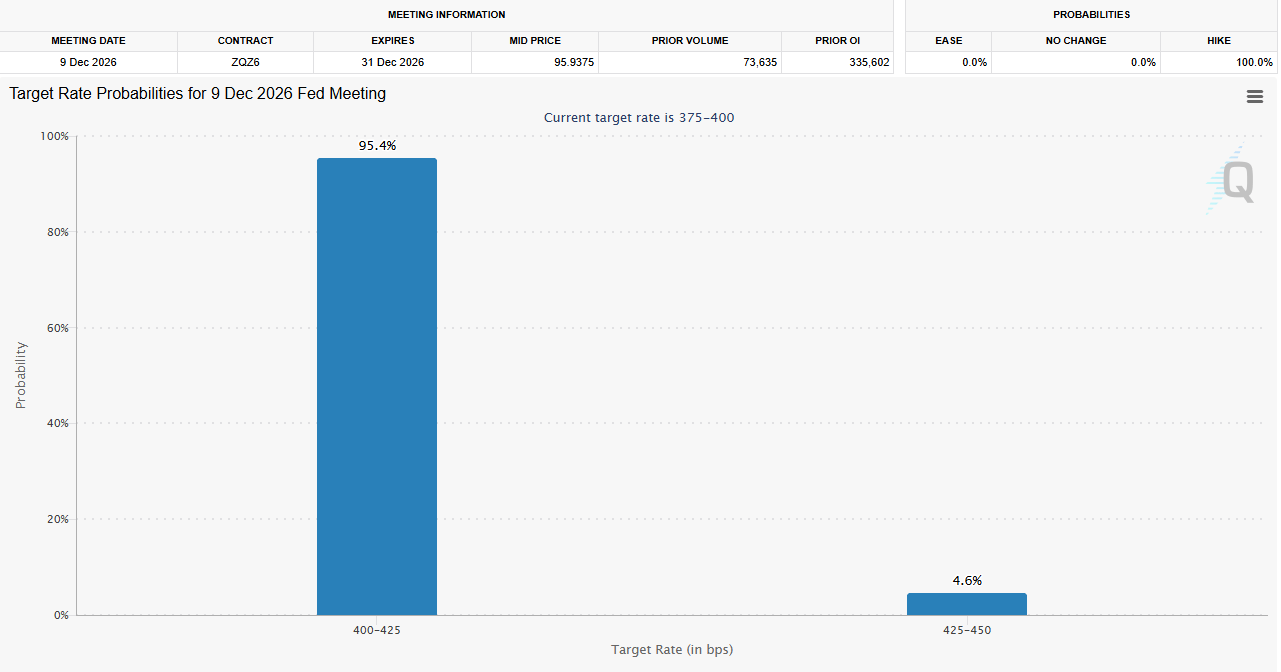
The outlook remains supportive of elevated US bond yields, with the benchmark 10-year US Treasury note holding comfortably above the 5% threshold and hovering near its highest level in one month. This, along with persistent geopolitical tensions in the Middle East, lifts the safe-haven USD to a fresh high at 103.70 on the US Dollar Index (DXY), a level not seen since April 2025, which limits BTC recovery prospects.
Institutional demand continues to weaken
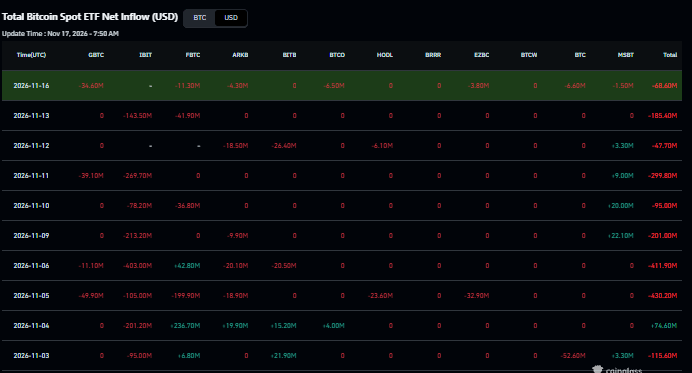
Institutional demand for Bitcoin began the week on a negative note. CoinGlass data shows BTC spot ETFs recorded a $68.60 million outflow on Monday after two consecutive weeks of billion-dollar outflows. If this outflow trend continues and intensifies throughout this week, it could put additional pressure on BTC, pushing its price into further correction.
Bitcoin technical outlook: Selling pressure dominates despite the risk of a corrective bounce
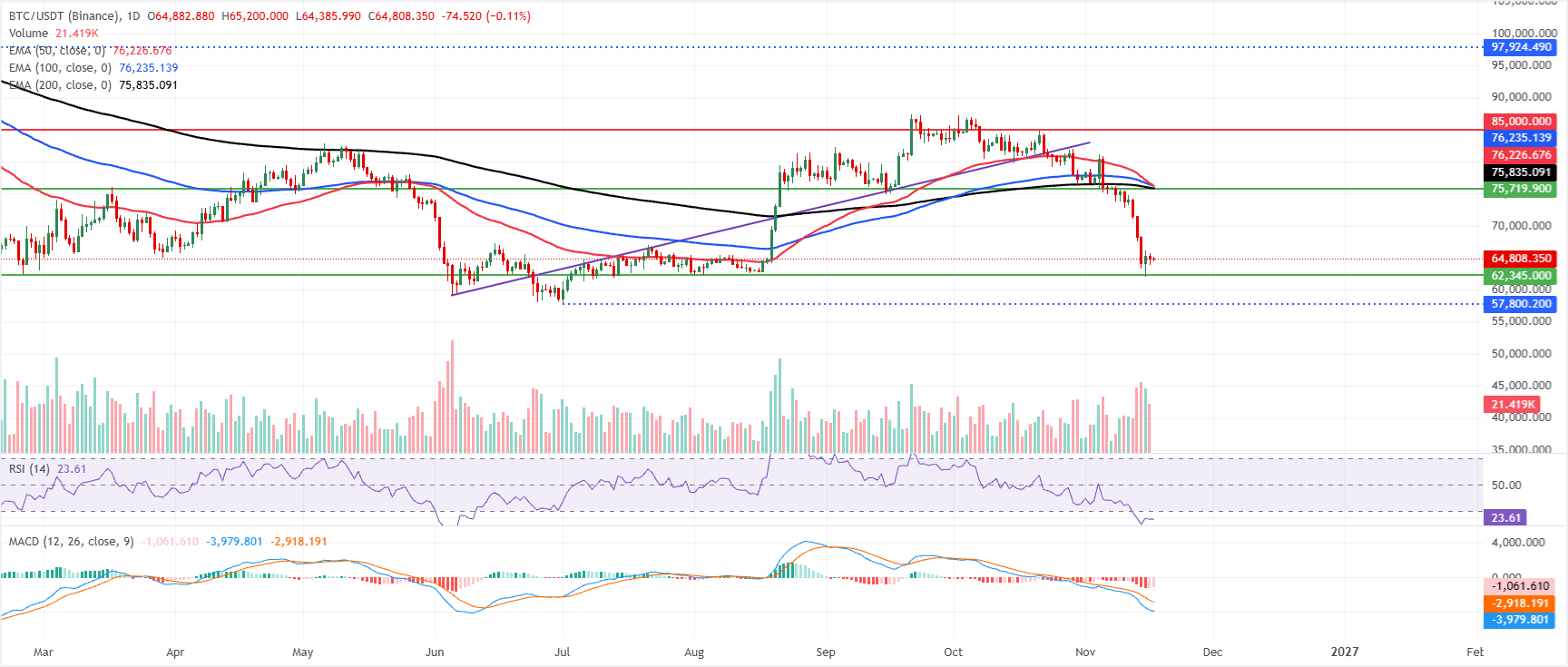
Bitcoin price trades at $64,808 on Tuesday, extending its slide well below the 50-day, 100-day and 200-day Exponential Moving Averages (EMAs), which collectively cap the upside between roughly $75,835 and $76,235.
This configuration keeps the near-term bias firmly bearish, as BTC holds under all major trend gauges. At the same time, the Relative Strength Index (RSI) languishes in oversold territory near 23, and the Moving Average Convergence Divergence (MACD) indicator remains deeply negative, suggesting selling pressure still dominates despite the risk of a corrective bounce.
On the topside, initial resistance is seen at the 200-day EMA around $75,835, followed closely by the 50-day EMA at $76,226 and the 100-day EMA near $76,235, forming a dense cluster that would need to be reclaimed to ease the bearish tone. A more significant barrier stands at the horizontal level of $85,000, where prior supply could re-emerge if a stronger recovery materializes; until these ceilings are challenged, BTC is likely to remain vulnerable to further downside or consolidation at depressed levels.
(The technical analysis of this story was written with the help of an AI tool. Know more.)
Bitcoin, altcoins, stablecoins FAQs
Bitcoin is the largest cryptocurrency by market capitalization, a virtual currency designed to serve as money. This form of payment cannot be controlled by any one person, group, or entity, which eliminates the need for third-party participation during financial transactions.
Altcoins are any cryptocurrency apart from Bitcoin, but some also regard Ethereum as a non-altcoin because it is from these two cryptocurrencies that forking happens. If this is true, then Litecoin is the first altcoin, forked from the Bitcoin protocol and, therefore, an “improved” version of it.
Stablecoins are cryptocurrencies designed to have a stable price, with their value backed by a reserve of the asset it represents. To achieve this, the value of any one stablecoin is pegged to a commodity or financial instrument, such as the US Dollar (USD), with its supply regulated by an algorithm or demand. The main goal of stablecoins is to provide an on/off-ramp for investors willing to trade and invest in cryptocurrencies. Stablecoins also allow investors to store value since cryptocurrencies, in general, are subject to volatility.
Bitcoin dominance is the ratio of Bitcoin's market capitalization to the total market capitalization of all cryptocurrencies combined. It provides a clear picture of Bitcoin’s interest among investors. A high BTC dominance typically happens before and during a bull run, in which investors resort to investing in relatively stable and high market capitalization cryptocurrency like Bitcoin. A drop in BTC dominance usually means that investors are moving their capital and/or profits to altcoins in a quest for higher returns, which usually triggers an explosion of altcoin rallies.
Recommended Articles









Comments (0)
Click the $ button, enter the symbol, and select to link a stock, ETF, or other ticker.