


Mazda engineers put OpenAI's GPT-6 Astra to work on vehicle aerodynamics



OpenAI announced a research partnership with Mazda on Tuesday, bringing together its engineers with the automaker’s aerodynamics and crash-safety teams.
The work looks into the possibility of using OpenAI models to design and evaluate new vehicles.
GPT-6 Astra models new nose shapes to cut drag
According to a Nov. 3 post on the company’s website, the Mazda work involves OpenAI’s research and Forward Deployed Engineering teams. Simulations of airflow and structure test performance gains, with styling and cost in mind.
In aerodynamics, GPT-6 Astra models new nose shapes, simulates airflow and fine-tunes the most promising designs. The goal is less drag.
“By exploring and simulating dozens of variations, Astra in Codex helps us understand which features matter for aerodynamics and where designers have room to explore,” said Akihiro Nakata, principal engineer at Mazda.
Over the coming months, OpenAI will share its progress and results.
Newer internal model scores 0.875 on BenchCAD 2.0
A more recent internal model from OpenAI got a score of 0.875 on BenchCAD 2.0. GPT-6 Astra’s highest reasoning setting attained 0.594.
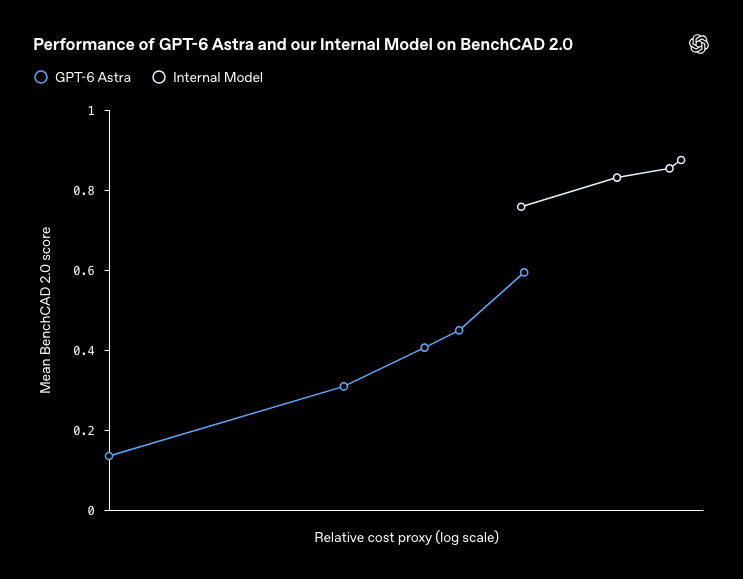
The benchmark tests models on their ability to reconstruct 3D parts and assemblies, and to find connections in circuit boards. The use of the models across OpenAI’s hardware teams has grown 23-fold in tokens since February.
Those teams are employing Codex and ChatGPT for CAD models, manufacturing drawings, setup simulations and design reviews. The work includes compute infrastructure and robotics.
Plus, OpenAI is extending its partnership with Chip Ganassi Racing. The first year concentrated on data from car sensors, races and pit crews.
This new phase is about converting 3D scans of existing parts into CAD models that can be edited and into 2D manufacturing drawings. It is aimed at parts where the original design files are unavailable.
“The feedback I give the model is directly applied, the manual tweaks can be made directly, and this has become a faster, more hands-off process for me,” said Matthew Ortman, an R&D engineer at Chip Ganassi Racing.
In under a week, two OpenAI employees used Astra in a side project to create a device to talk to Codex. Astra handled the enclosure, board, firmware and software links, and a contract manufacturer built a small run of prototypes in under a month.
It still took several rounds of review to get it ready for production. Astra did not always weigh the manufacturer’s manufacturing limits, tolerances, or assembly details.
In a court filing on Oct. 14, OpenAI said a former employee had moved more than 100 confidential files about its own unreleased device to personal accounts.
Cryptopolitan reported in September that Astra was shipped as the first model rated “Critical” for cybersecurity under OpenAI’s own safety framework. Now, OpenAI is soliciting proposals from engineers, engineering firms and software vendors for future work.
If you're reading this, you’re already ahead. Stay there with our newsletter.
Recommended Articles







Comments (0)
Click the $ button, enter the symbol, and select to link a stock, ETF, or other ticker.