


Meta postpones AI content terms to November 20 under publisher pressure



Meta has postponed the implementation of its revised Commercial Terms and Self-Serve Ad Terms to November 20. Originally set to be implemented on October 30, the revised schedule come after some publishers and advertisers raised concerns regarding a new website-crawling provision. The outcome of this decision will determine who holds the right to use journalistic content in AI products.
Three more weeks to explain what Meta says isn’t changing
On 23 October, Reuters reported that the complaints had been submitted to the EU and UK competition authorities. Meta dismissed the allegations about wanting to have unlimited rights to content published online. The company said that the postponement gives it a chance to give an explanation about its crawlers. It also reminded publishers of the fact that they have a right to exclude or allow the usage of their sites through robots.txt, a file giving instructions to automated bots.
Publishers call the delay “a pause, not a solution”
Publishers are looking for more than just a sense of security. UK News Media Association chief Theo Bamber referred to the postponement as “a pause, not a solution,” and urged the introduction of legally binding commitments.
In a letter dated October 22, WAN-IFRA called for binding robots.txt protections, revocation of Meta’s permission to generate test credentials, measures preventing the bypassing of paywalls, as well as the possibility of opting out of crawling without losing access to business tools.
WAN-IFRA president Ladina Heimgartner summed up the industry’s concerns:
Journalism is not raw material to be collected as a condition of being present on a platform.
What the disputed clause actually allows
The issue is in the language. Meta’s revised terms allow the automatic harvesting of data from online content “associated with” business accounts for the purpose of creating advertisement and business products.
Meta has dropped the word “training.” However, legal experts told Nieman Lab that “develop” may still be interpreted as AI training. Moreover, the new terms do not contain any explicit statement that robots.txt will be honored. Meta disputes that reading.
Brussels welcomes the pause, Blackburn wants a withdrawal
The postponement has not contributed much to easing regulatory concerns. Although the European Commission welcomed the move, Britain’s Competition and Markets Authority said it would continue examining Meta’s terms.
There is also an increasing call by publishers for better protections. Angela Mills Wade, the executive director of the European Publishers Council, stated that there should be no reason for the company to gain control over publishers’ content simply due to it having a Meta business account. In the US, Senator Marsha Blackburn has even demanded that the company guarantee the withdrawal of the new terms altogether.
Why the fight reaches past newsrooms
The dispute goes beyond publishers’ control over their content. It could also affect the growing market for AI licensing deals. As Cryptopolitan reported on October 15, CNN joined Google’s paid News AI pilot, which now includes more than 400 publications.
Such deals may be harder to reach once platforms are allowed to access content more broadly under their commercial terms. Small AI developers may also suffer against those firms that have control over both distribution and access to content. The OECD points out that the current concentration of AI resources plus vertical integration entails risks for competition.
Still, publishers are not counting on licensing to deliver substantial revenue. The Reuters Institute’s 2026 survey found that only 20% of publisher respondents expected substantial AI-related income. Another 49% anticipated minor contributions, while 20% expected none.
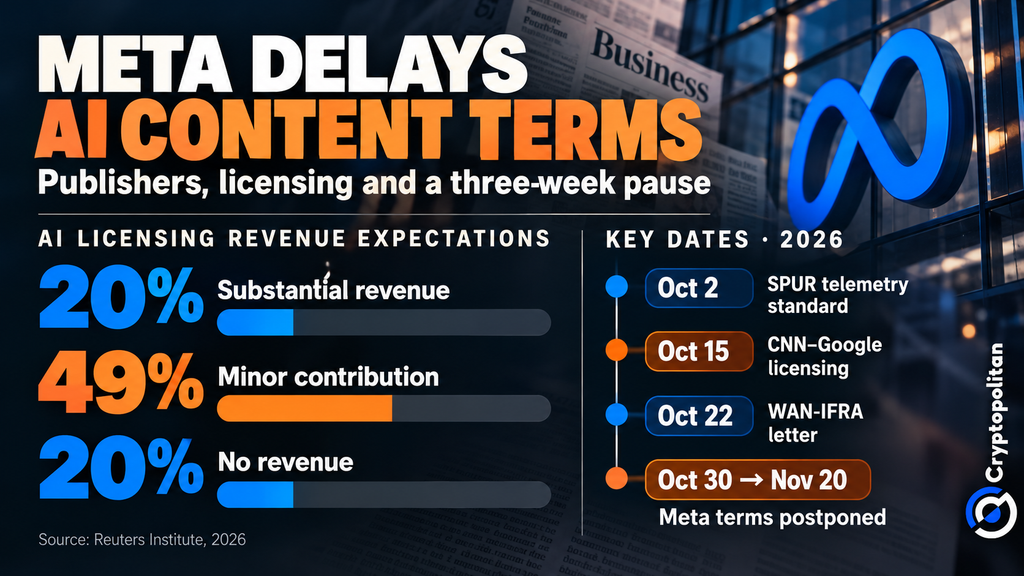
Better tracking could help publishers negotiate. On October 2, the SPUR Coalition introduced a telemetry standard to record when AI systems retrieve or cite their content. It could strengthen their bargaining position, although it cannot guarantee payment.
For now, publishers want Meta to turn its assurances into binding protections for crawling, opt-outs, and licensed AI use before November 20.
Don’t just read crypto news. Understand it. Subscribe to our newsletter. It's free.
Recommended Articles





Comments (0)
Click the $ button, enter the symbol, and select to link a stock, ETF, or other ticker.