


Europe's telecom giants chase satellite sovereignty without a fleet



On October 19, 2026, Deutsche Telekom, Orange, Telefónica and Vodafone entered into a letter of intent to explore a possible joint bid for the European satellite spectrum. Their goal is to enable regular mobile phones to connect to satellites without the need of a proprietary, dedicated system. No license has been issued in connection with this project, and there is as yet no satellite partner.
A consortium that wants the ground, not the satellites
The four companies would maintain ground infrastructure, network coordination and monitoring in Europe. However, another partner would have to supply the spacecraft. Other mobile operators would receive open, non-discriminatory access to direct-to-device (D2D) services.
Existing partnerships would not change, including the one with Vodafone. As a result, no funding will need to be spent on building a fleet, but dependence on technology and launches provided by an operator outside of Europe remains.
The clock on the 2 GHz band
Spectrum rights given in 2009 and held by Viasat and EchoStar will come due in May 2027. The European Commission proposed new EU-wide licensing rules on May 27, 2026.
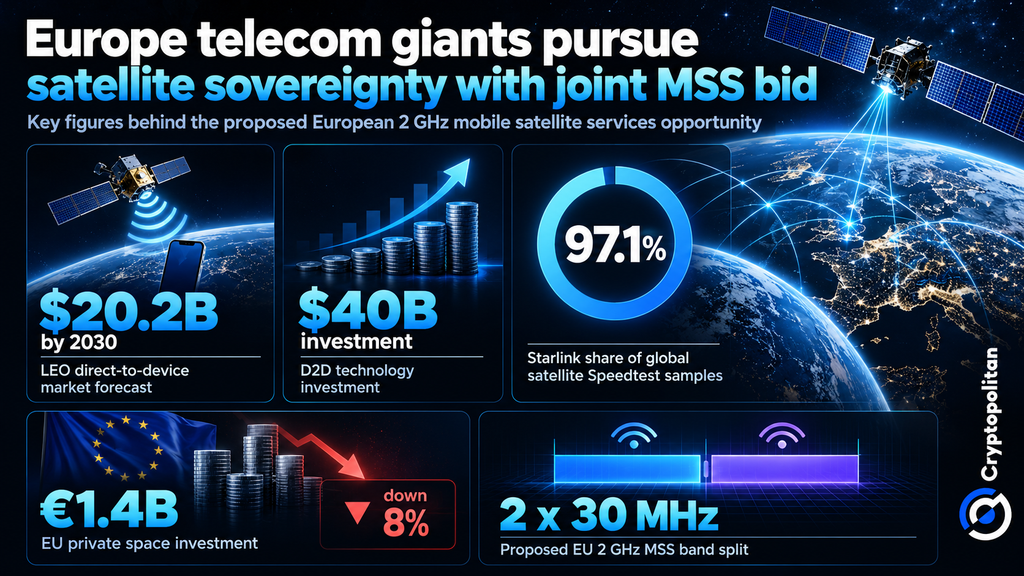
Its 2 × 30 MHz frequency band is to be allocated as six coupled 5 MHz blocks: the first third to EU-controlled governmental communications associated with IRIS²; the next third to EU-reserved commercial services; and the remaining third allocated to both EU and non-EU qualifying operators. The incumbents may get a two-year extension.
“More than ever high-capacity, widely available satellite connectivity is essential to strengthen the resilience of the EU’s communication networks.”
— Henna Virkkunen, European Commission executive vice president, May 27 statement.
Why the last regime stalled
According to a white paper published by IDATE in June 2026, countries have not deployed radio equipment under the licensing systems uniformly, and there is little commercial argument in favor of the systems. Enacting rules at the European level might solve this issue, but reserving frequency bands for use by European companies could lead to disputes with foreign operators.
What the D2D demand actually looks like
According to Gartner’s forecast dated September 2, 2026, the size of the market for low-earth orbit (LEO) D2D is projected to reach $20.2 billion in 2030 with more than one hundred companies intending to enter the field. Ookla’s research published in August 2026 indicates that investment in D2D systems reached more than $40 billion during the previous year.
For now, D2D is more about maintaining connection than with providing speedy connections. All tests in the US show that about ninety percent of text messages succeed even on moving vehicles. The same technology was used to keep communication with the people after earthquakes that took place in Venezuela. However, adoption varies widely across markets.
Ookla also measured Starlink at 97.1% of global satellite Speedtest samples in the third quarter of 2025. That measures satellite broadband tests, not D2D market share.
Sovereignty or contractual dependence?
European operators could have control over licences, ground operations, and customer access. However, the satellites would remain to be owned by an outside provider.
The investment gap helps explain why. ESA found that European private space investment dropped 8% to €1.4 billion in 2025, even as global investment jumped 60%. Cryptopolitan previously reported that SpaceX deployed 26 Starlink V3 satellites on September 28, 2026. That shows just how difficult it would be for European operators to compete at the same scale.
So the question now is whether European operators will manage to find a reliable satellite partner and get regulatory approval without becoming too dependent on their outside provider.
If you're reading this, you’re already ahead. Stay there with our newsletter.
Recommended Articles





Comments (0)
Click the $ button, enter the symbol, and select to link a stock, ETF, or other ticker.