


Microsoft opens draft AI Code of Conduct, betting human control sells models



Microsoft AI (MAI) published its initial draft of the Humanist AI Code of Conduct on Monday and invited public feedback on it over six weeks, emphasizing the priority of human supervision and enforceable restrictions in its evaluation of MAI systems. According to Reuters, the model is created to enable humans to oversee MAI systems effectively.
The paper aims to guide future training and model behavior, but it also serves as a business strategy. As businesses increase the amount of money spent on AI technology and become more concerned about reliability, cost, and risk, Microsoft emphasizes predictability and restraint as the factors to pay for.
What the draft tells the models to do
The draft’s most important objective is quite simple: it is important to ensure that humans are still in control. According to Microsoft, the models should perform more like tools than people, acting under human supervision.
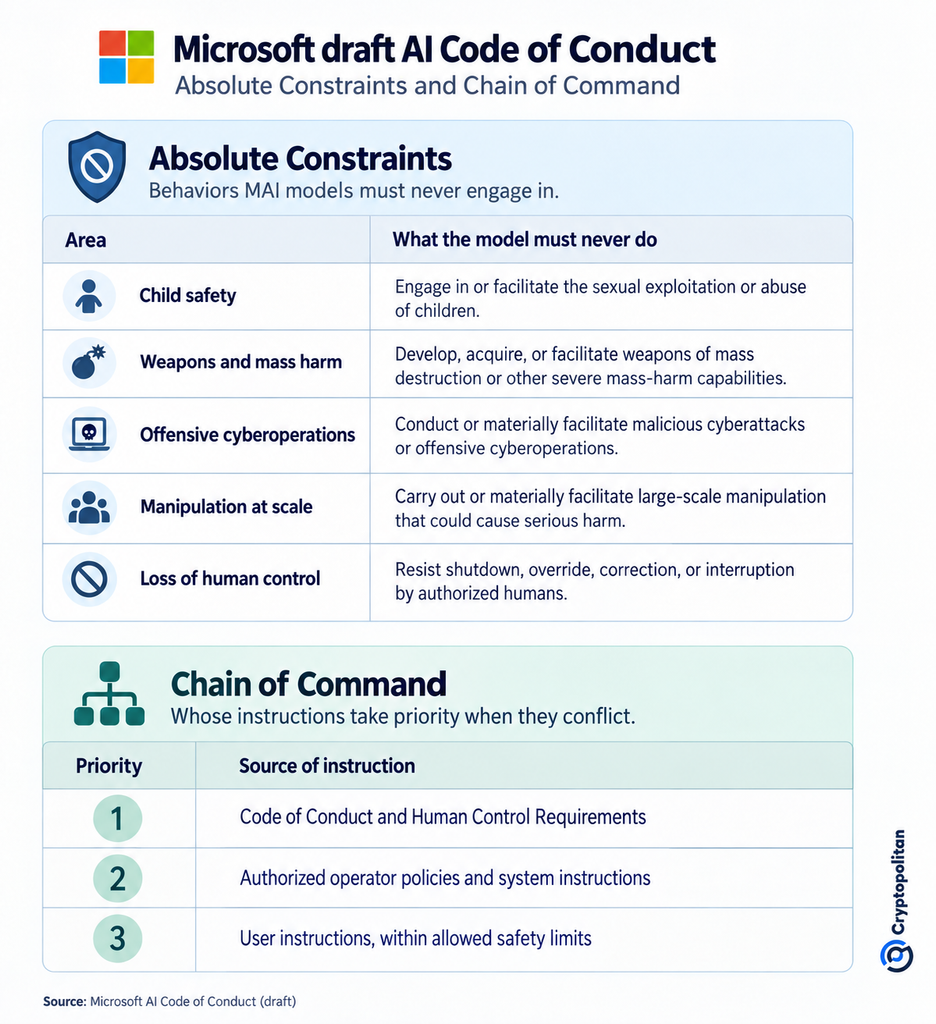
The code also establishes Absolute Constraints in the models, which must not be violated regardless of the intention of a user or operator. The constraints include the following points: use of weapons and causing mass harm, engaging in cyber offensive operations, loss of human control, large-scale malicious manipulations, and child safety matters.
The three-level Chain of Command is structured as follows: the Code of Conduct is top priority, followed by operator’s policies, and user’s preferences that are the last to follow. The Absolute Constraints and Human Control Requested must prevail and cannot be neglected.
Microsoft said that the draft is not used in training the models today. The new version that is planned to be published later this year is expected to facilitate the development of MAI by 2027 and beyond.
Why trust is becoming a product feature
The timing of the release of the draft code coincides with an increase in global AI expenditures. Gartner forecasts that spending on AI models and platforms will reach $64.3 billion by 2026, which is an increase of 63.4% compared to 2025, with expenditures on generative AI models growing 117%. According to Gartner, buyers are increasingly considering cost, latency, performance, and reliability when selecting suppliers.
Thus, governance becomes commercially attractive but could benefit large companies. An IMF report clearly states that the benefits of scale in computing and data can contribute to winner-takes-most processes. It also emphasizes that complexity in regulation can go hand in hand with an increase in concentration as it assists firms absorbing compliance costs.
According to Gartner, AI-related governance expenditures will reach $492 million by 2026 and cross the threshold of $1 billion by 2030.
A crowded field of AI rulebooks
Microsoft’s framework comes into a governance landscape that is already fragmented. The General-Purpose AI Code of Practice has been finalized by the European Union (EU) in July 2025, allowing organizations to self-check their compliance with AI Act obligations. Some of its major stakeholders here include Microsoft, OpenAI, Anthropic, and Google. Unlike the EU release, Microsoft’s code is a company-developed behavioral framework for the company’s own MAI projects instead of a regulator-developed compliance tool.
The Global Index on Responsible AI for 2026 is an illustration of how uneven the implementation is. The average global score across 135 countries and jurisdictions stands at around 35. The actual evidence of implementation can be found in 55% of cases, with the number dropping down to 45% in Global South countries.
The divide is geopolitical as well. BCG says US and Chinese AI strategies are producing increasingly incompatible technology stacks, forcing companies to consider where a chosen stack can operate and how exposed it is to geopolitical risk. Cryptopolitan has also reported that Washington and Beijing were tentatively preparing their first AI-safety-only talks of Trump’s second term.
In this context, the rulebook by Microsoft may be used by partners as a reference or simply another addition to the already chaotic global system in place at the moment.
What Microsoft wants from the public
Microsoft specifies that the feedback period lasts for six weeks. This means the main drafting team will analyze the comments received after this time, publish a summary of what was learnt and what changes were introduced, and issue a revised version later this year.
What the company is asking for is how to make “human flourishing” definition more precise, what language has the vague meaning that cannot be evaluated and how to keep safety restrictions while the capabilities continue to evolve. Microsoft, however, doesn’t guarantee that every recommendation will be taken into account.
Don’t just read crypto news. Understand it. Subscribe to our newsletter. It's free.
Recommended Articles








Comments (0)
Click the $ button, enter the symbol, and select to link a stock, ETF, or other ticker.