


 Discount


Gold rebound loses steam as Fed interest rate hike bets weigh



- Gold struggles to build on Monday’s rebound as a hawkish Fed outlook limits buying interest.
- A modest retreat in the US Dollar from a 20-month high helps cushion Gold’s downside.
- XAU/USD faces immediate resistance at $3,700, while momentum indicators remain bearish.
Gold (XAU/USD) trades slightly lower in quiet European trading on Tuesday. A hawkish Federal Reserve (Fed) outlook keeps buyers cautious after the previous day’s rebound from its lowest level in more than a year. At the time of writing, XAU/USD trades around $3,620 after touching an intraday high of $3,678.
The metal rose 3.1% on Monday as Nvidia’s decision to bring back Jensen Huang as CEO sparked a rebound on Wall Street. That eased selling pressure on precious metals after last week’s equity sell-off prompted some investors to sell Gold to cover losses and meet margin calls.
As market sentiment stabilises, attention turns back to how quickly the Fed might raise rates. Officials continue to signal that tighter policy is needed to bring inflation down, and traders are pricing in a series of rate hikes over the coming months. Higher borrowing costs typically hurt Gold, which doesn’t pay interest.
Fed’s Williams keeps hawkish bias as data guide rate path
Analysts at Danske Bank note that Fed’s John Williams, a permanent FOMC voter, reiterated on the wires that “persistently high inflation continues to point the Fed towards tighter monetary policy,” while emphasising that the “pace of future rate increases will depend on incoming data.” Williams added that he does not have “a particular timing” in mind for the next moves but would not exclude “moving at consecutive meetings if needed.” Danske Bank argues that these remarks “confirm the broadly hawkish tone from Fed officials in recent weeks” and “support our call for 25bp hikes in December, January and March.”
The prospect of further Fed tightening keeps the US Dollar (USD) broadly supported, though a slight dip on Tuesday helps limit Gold’s losses. The US Dollar Index (DXY) trades around 104.15 after reaching a 20-month high of 104.53 on Monday.
Tuesday’s US economic calendar is light, with Consumer Confidence the main release. The bigger test comes on Wednesday with the October Personal Consumption Expenditures (PCE) Price Index, the Fed’s preferred inflation gauge, and the second estimate of third-quarter US Gross Domestic Product (GDP).
Technical analysis: Weak momentum keeps downside risks intact
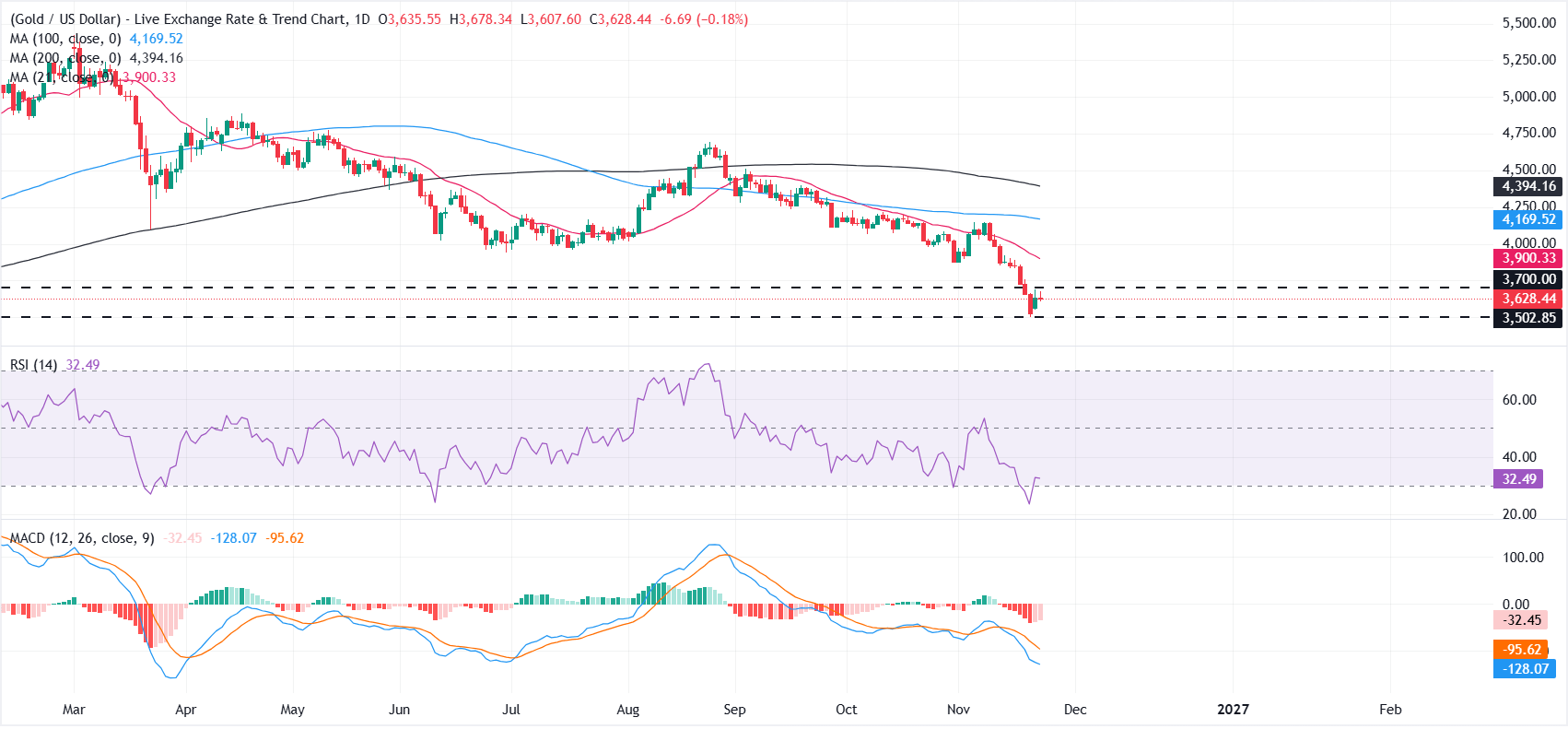
On the daily chart, XAU/USD retains a bearish near-term bias, holding firmly below the 21-day simple moving average (SMA) and the longer-term 100-day and 200-day SMAs. The cluster of overhead moving averages suggests rallies remain corrective within a broader downtrend, while the Relative Strength Index (RSI) at 32 hovers near oversold territory and the Moving Average Convergence Divergence (MACD) indicator stays deeply negative, reinforcing persistent downside momentum rather than signaling a solid base.
On the topside, initial resistance is seen at the horizontal barrier near $3,700, ahead of the 21-day SMA at $3,900, with further upside capped by the 100-day SMA at $4,169 and the 200-day SMA at $4,394. On the downside, Friday’s low of $3,502 is the next key support. A sustained break below it could extend the decline, while a hold above it could prompt modest short-covering towards resistance at $3,700.
(The technical analysis of this story was written with the help of an AI tool. Know more.)
Gold FAQs
Gold has played a key role in human’s history as it has been widely used as a store of value and medium of exchange. Currently, apart from its shine and usage for jewelry, the precious metal is widely seen as a safe-haven asset, meaning that it is considered a good investment during turbulent times. Gold is also widely seen as a hedge against inflation and against depreciating currencies as it doesn’t rely on any specific issuer or government.
Central banks are the biggest Gold holders. In their aim to support their currencies in turbulent times, central banks tend to diversify their reserves and buy Gold to improve the perceived strength of the economy and the currency. High Gold reserves can be a source of trust for a country’s solvency. Central banks added 1,136 tonnes of Gold worth around $70 billion to their reserves in 2022, according to data from the World Gold Council. This is the highest yearly purchase since records began. Central banks from emerging economies such as China, India and Turkey are quickly increasing their Gold reserves.
Gold has an inverse correlation with the US Dollar and US Treasuries, which are both major reserve and safe-haven assets. When the Dollar depreciates, Gold tends to rise, enabling investors and central banks to diversify their assets in turbulent times. Gold is also inversely correlated with risk assets. A rally in the stock market tends to weaken Gold price, while sell-offs in riskier markets tend to favor the precious metal.
The price can move due to a wide range of factors. Geopolitical instability or fears of a deep recession can quickly make Gold price escalate due to its safe-haven status. As a yield-less asset, Gold tends to rise with lower interest rates, while higher cost of money usually weighs down on the yellow metal. Still, most moves depend on how the US Dollar (USD) behaves as the asset is priced in dollars (XAU/USD). A strong Dollar tends to keep the price of Gold controlled, whereas a weaker Dollar is likely to push Gold prices up.
Recommended Articles








Comments (0)
Click the $ button, enter the symbol, and select to link a stock, ETF, or other ticker.